Life’s Work

David Milch

Published: September 13, 2022

Read: October 10, 2022

Life’s work was not the memoir of sex, drugs, and television production I was expecting. I was familiar with the author, the television show writer David Milch, creator of Deadwood (which I have watched and love) and NYPD Blue (which I have not seen). Life’s work is a book concerning a man who created some good television and had a more than average grasp of language and story telling. The memoir is not limited to behind the scenes Hollywood insights, but takes that base and layers on ideas of memory faith and trauma that go a bit beyond.

Beyond the accomplishments and trials of Milch’s professional life, this book is about aging, and difficulty recounting life while the one living is still around. At the time of writing, David Milch has been diagnosed with Alzheimer’s disease, and is living in an assisted care facility. Life’s Work was written with the assistance of journals throughout Milch’s life and his wife, friends and other family recollections to round out the tale. At my own middling age of 33, I haven’t been too closely acquainted with death or the loss of one’s mind. I have two living grandparents even though I’ve lost two already who i knew well.

David Milch was born in 1945. He describes his childhood and his relationship with his father. A doctor professionally and a non-professional gambler at the racetrack. The younger Milch admits this may have established the bedrock of what may be an obsessive or self hating cycle of excitement and failure repeated constantly that is much like wagering $50 on 8:1 odds at the track. His abuse at the hands of another adult during his time as a child. At some point whether spoken or unspoken, David is appointed within the Milch family to be the token fuck-up, even as he became a writer and grabbed success. His travels through college and beyond into writing for TV.

Milch is a religious man, he believes in Jesus Christ but infuses his faith in god with a few wry jokes. His belief in Jesus Christ emerges throughout the stories he has written over the years, and had the man himself featured in a particular Episode of NYPD Blue . Milch recounts that the impetus for the show that became Deadwood was a story involving St. Paul in Rome and his life of suffering and trying to do right by God. How Deadwood emerged was replacing the searching for God for searching for gold in the old west.

The last chapter somberly serves as I think a summation or perhaps an obituary, written by a man who knows his mind is fleeting, if not his life, and is scrambling to put it onto paper. I’ve never felt so moved by this book that should just be a “hey a fuckup went to Yale and made some tv” memoir.

Life’s Work left an impression on me. The impression given from a man who’s life is coming to an end, who sat with me for a while and made me realize that maybe in the grand scheme of the cosmos, someone born in 1945 may be closer to my age than I’d like to believe, and the time we have is indeed fleeting.

And hot damn the writing is fantastic.

Carrying the Fire

Michael Collins
Published: 1974
Read: 7/30/22

I just don’t know how long it takes, except that it had taken me thirty-five years to reach crew quarters at Merritt Island, Florida, and on July 17, 1966, I felt ready. I felt it had taken exactly the right amount of time.

Michael Collins, Carrying the Fire, 1977

Carrying the Fire is the story of Michael Collins, a man who went to the moon. A man who used a period of his life, to achieve this singular purpose above all else.

I started this book while on a plane ride to LAX to support the flight test of a customer that was in dire need of getting my flight test equipment to work inside their vehicle. Equipment that should work for them but in this case definitely did not. Reading Carrying the Fire on that plane, reminded me that I’m living with the descendants of everything NASA did technologically on Apollo. The current commercial space sector with SpaceX (documented in Liftoff) and Blue Origin as NASA prepares the return to the moon on the new Artemis missions. I’m also a bit embarrassed that I never dug into this period of rapid exploration and innovation and discovery until now.

The closest I’ve come to reading about astronauts is the Chuck Yeager book, Yeager in fifth grade. My dad (and dads everywhere who love airplanes) was wild about that book of faster than Mach 1 flight. For context Yegars time was happened in the late 40s and he brushed up against NASA in 62, according to Wikipedia. And speaking of other aviation icons the introduction to the book was originally written by Charles Lindbergh.

Returning to the book, Collins describes his life pre-1969, the life of a fighter pilot that changed into something entirely different by the end. It will become an astronaut’s life. Collins is a man who thrives off of going faster and doing things that will surely get him killed, two things that do not motivate me in the slightest. In truth, I get my heart racing and hair on end from nothing more than the stress of a presentation talk or design review. Although all events were documented in detail the book is written with very little discussion of why Collins continued to move in this direction. Was he detached from the situation or embraced it entirely? Any doubts or internal monologuing of this sort is kept out of Carrying the fire for the most part to keep with the momentum of his part in Apollo.

We found naïve people who sincerely believed that if an astronaut said it, it must be so, and shrewd people who enticed us into making pronouncements that could be used to reinforce their own parochial viewpoints.

Michael Collins, Carrying the Fire

Collins sketches out a meandering road to get to the NASA program. Never did it appear that Mike dreamed of being an astronaut (perhaps because the profession only existed five years before he did it) but he takes it as a matter of course that it was his chosen path. Perhaps that’s the military piece of this man. Grow up take orders push the limits but there are always orders and directions.

The detail on all the procedures and methods associated with the moon mission really got me. I also laugh because Seveneves proved to be as reliable as this book when referring to orbital mechanics, which I suppose is good on Stephenson. Of particular note is the construction of the space suit and the iterations to trade off safety and mobility which was extremely lacking.

I’ve never heard the Apollo story from front to back, so many events captured me the whole way through. Ten astronauts tragically died during the course of the mission. A few of them dying in airplane crashes before getting anywhere near the pad. Four dying because of the pure oxygen environment on the pad being ignited by some failure and the team at NASA speculating if they suffocated before they were burned. The entire logistics of setting positions related to the stars only being checked by a computer that could seemingly only run those computations.

If the pilot moves his hand an inch or two sideways, he instantaneously commands three thousand pounds per square inch of hydraulic pressure to actuate cylinders which deflect large ailerons into the speeding slipstream.

Michael Collins, Carrying the Fire, 1977

Collins also clearly is speaking to the reader from another era. He brings up that running every day is very beneficial in a way that your friend would when they have brought up drinking low grade snake venom helps their skin. He jokes about needing martinis and chasing women in a multiple sections of the book, and he was young to middle aged married man in the duration. Mostly the book is, a pilot and a military man (not to imply lack of education) telling his part in the exploration of a new frontier.

As Collins describes in words the vastness of space and the exiting of the atmosphere and all the views that did and did not get back to early on film I find myself looking up more often. And thinking on what a life is if not pushing to do something incredible and then surviving or not. This was a fantastic book I would recommend to anyone who has wanted to explore or do something with their lives that mattered and understood the sacrifices and time scale of accomplishing those things.

In my own view, the pendulum has swung; rockets are about as interesting as the powder which propels a bullet. To be fascinated by them is to prove McLuhan’s point that the medium is the message, or perhaps it is a more Freudian thing.

Michael Collins, Carrying the Fire

Random Observations

  • The history of aerospace companies in 1967 versus today. All predecessors of the current names. Although as with most things different men and different times. North American Rockwell, Lockheed, McDonnell, Grumman. I imagine the full names now but these were the complete names at the time
  • This book came on my radar from Penn Jillette, saying something like PSS 705
  • The descriptions of the capsules should be seen as well to understand the difference between the video we see now of the ISS versus what they had during the Apollo years.
  • Artemis mission
The Command Service Module Capsule
James Humphreys – SalopianJames, CC BY-SA 3.0 https://creativecommons.org/licenses/by-sa/3.0, via Wikimedia Commons

Termination Shock

Neal Stephenson
Published: 11/16/21
Read: 12/28/21

Termination Shock takes its time, and is quite meandering for a thriller. After 800 some pages, the book makes me feel like I only watched the Season 1 finale of the a new slow burn TV series.

Termination Shock is set in the near future, is centered around climate change, and one individuals efforts to do something about it himself. That man is TR Schmidt, and his plan is to launch rockets to blast sulfur dioxide in the air from his ranch in Texas. Oh and also to collect a cabal of people to back him in his play for spreading this radical geoengineering scheme across the globe. The characters being charmed by the renagade Texan include the Queen of the Netherlands, Venetian nobles (who are quite bitter about their city potentially being demolished), and the mayor of the City of London amongst others.

I find writing this synopsis now, that I’m still excited about Termination Shock and this premise even a month after I finished reading. The pieces are set for a massive adventure with high stakes and big reveals, double crosses and ramifications echoing across the globe. I will admit, part of the fun I expected and did get a good bit of were the classic Stephenson tropes. There are plenty of the “big ideas”, scientific theories, cultural observations, and inane trivia swirling around our main plot that can spawn many separate internet deep dives on their own (see my Random Observations). And this is the demise of the excitement as Termination Shock progresses. Ultimately, the backstory of how a certain character develops a personal vendetta against wild boar hunting is more exciting than the revelations of climate change and how to change it. What left me feeling unfulfilled was the entry trailer, how would the world would be impacted by attempting this geoengineering. There are hints but no substantial answers, which left me feeling I missed the unwritten second half. Even towards the close of the book, there’s a growing conflict between two characters on different factions (a Cowboy and Indian showdown) that seems to cram in some excitement but at the expense of the contrast to the other 90% of the events.

In reading a novel about climate change, I was also a tad bit confused about the weather in this near future earth and how bad things actually were. The very intriguing earthsuits, full body suits that cool body temperature through liquids and air circulation are introduced within the first couple of pages and maybe it was my sci-fi expectations, but they don’t even reappear in a major way until the very end of the book. It also appears that they simply aren’t necessary except for maybe certain parts of Texas at high sun as opposed to generally applied across the earth. Not to mention, I was longing for Chekov’s earthsuit twist that never seemed to arrive.  

A high note is that in comparison to the “seven eves” of Seveneves I did have a connection to these characters in for what little time I spent with them.  Much like the characters in Reamde, but they frankly didn’t get to do much before the whole thing was over besides worry about whether or not our main character TR Schmidt was actually trying to achieve what was laid out on the blurb in advance of reading.

The entirety of Termination Shock, the reader is within characters perspectives who are not at the seat of the action. This isn’t intuitively bad but overall gives the feeling that the book kind of didn’t have a climax. The action is driven by TR who is continuously out of the understanding of each of the characters we spend time with.  Not to mention the Chinese involvement which is continuously under explained, or the perspective of anyone in the US government who notices a huge set of rocket launches occurring in Texas to pump sulfur in the atmosphere.  Stephenson does make his jabs at the current government through this lens and mentions the decline of America once or twice here as well as the events of the January 6th capital riot. T.R. is the sole American but the extreme rugged individual, and he is more the agent of chaos than the main character.

Perhaps this is intentional, Stephenson alluding to the fact that changing the climate is precarious, difficult and perhaps hes hinting the plan may never work. Either way the ending simply is not the end.

“Don’t worry, in Season 2 the Queen of the Netherlands might actually get with the Comanche Ex military guy. The wild Texan might actually get assassinated by the Chinese. The Dutch diplomat might actually… do something? “

Random Observations

  • Stephenson’s bibliography on climate and geo engineering topics as well as other interesting things in the general history of the world is probably going to help my “To Read” list for the next 30 years.
  • The Line of Actual control plays into a big chunk of this book. I learned it is an Actual thing, and its fascinating.

Books That Jake Happened to have Read in 2021

The Shelf

2021, what a year, one of those years where I couldn’t tell you how much happened and everything it meant to me… So I wrote about what i read instead. I hope you will find my insights interesting or enraging and let me know about it.

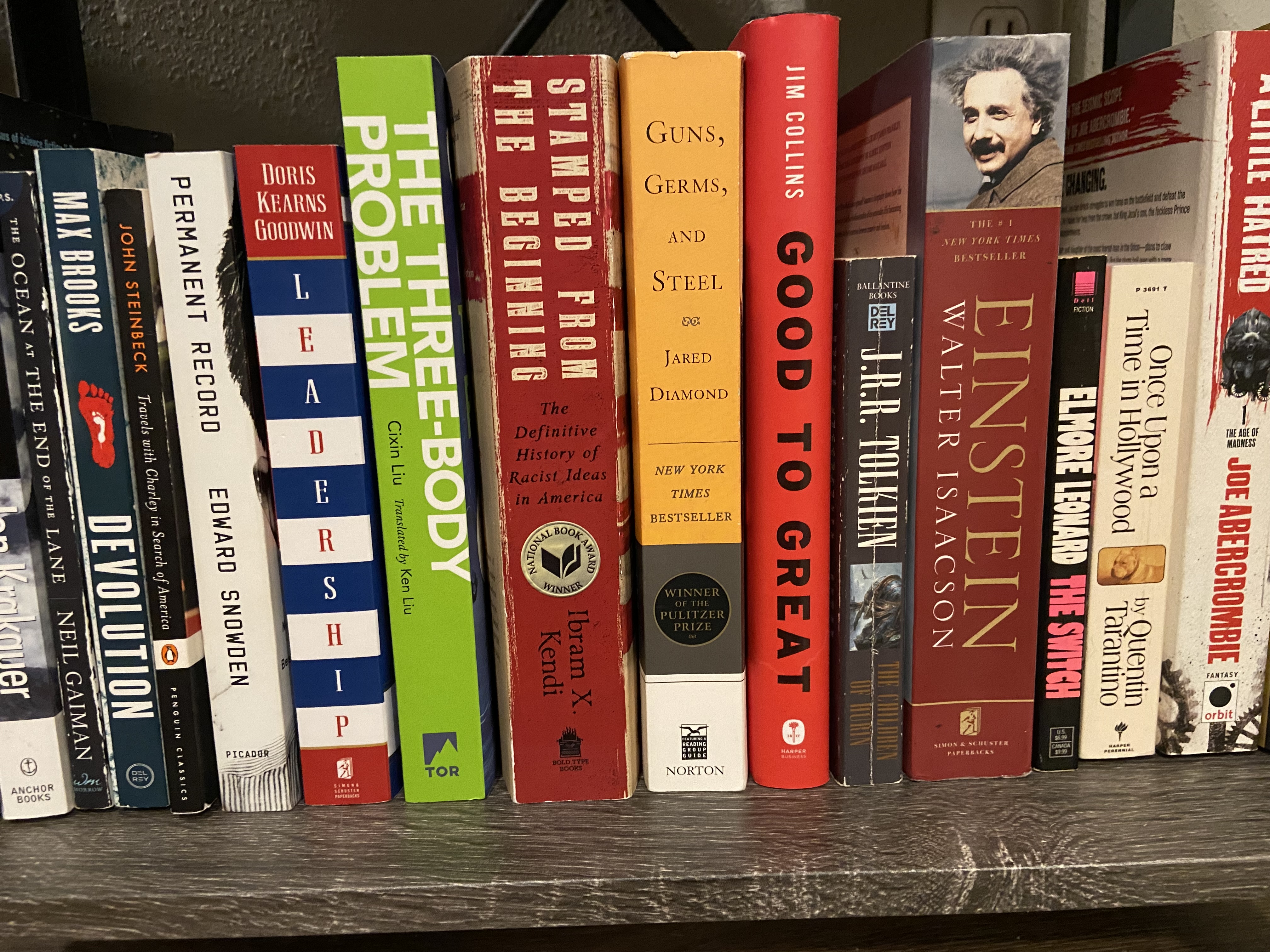
Out of all I’ve tried to read, I have a few I’ve actually finished and have written a few words on. If you’re interested please leave me a comment or call me in the middle of the night and we can talk about how wrong I got the whole situation or what we both found funny. I hope you enjoy them at least a little bit and let me know if you’ve read any yourself. If you are tight on time check out the Once Upon a Time in Hollywood review, Here’s to 2022, and actually getting through my full reading list list this year. Click through to see my thoughts on each book, and thanks for reading.

A Little Hatred by Joe Abercrombie

Lincoln in the Bardo by George Saunders

The Three Body Problem by Cixin Liu

10th of December by George Saunders

This is possibly my favorite book (collection of short stories this year), but I haven’t been able to explain why quite yet.

Leadership in Turbulent Times by Doris Kearns Goodwin

Travels with Charley: In Search of America by John Steinbeck

Permanent Record by Edward Snowden

The Code Breaker by Walter Issacson

Circe by Madeline Miller

Devolution: A Firsthand Account of the Rainier Sasquatch Massacre

Once Upon a Time in Hollywood by Quentin Tarantino

Liftoff by Eric Berger

Seveneves by Neal Stephenson

Termination Shock by Neal Stephenson

Unfinished Books

So i do have to mention a few books i didn’t finish this year right here, (links for not finished books are to Amazon, links for books I’ve read go to the review):

The Switch by Elmore Leonard

Amazon Link

The Rise and the Fall of the Third Reich by William L. Shier

Amazon Link

Embedded Software Timing by Peter Gliwa

Amazon Link

(I know some might complain that this is an engineering reference book, just be happy i didn’t put cookbooks on this list.)

Four Thousand Weeks, Time Management for Mortals by Oliver Burkeman

Amazon Link

Stamped from the Beginning by Ibrham X. Kendi

Amazon Link

I’ve been about 80% done this one all year and gained a ton by reading it. but I started on this whole writing reviews kick and haven’t gone back to wrapping this one up.

A Thousand Small Sanities by Adam Gopnik

Amazon Link

Liftoff 

By Eric Berger

Published: March 2021

Read: September 28, 2021

Liftoff describes a life and a situation that although not as exciting as it may be I have experienced.  The early days of SpaceX walk the line that is out of vogue now, but can become intoxicating if you catch it.  When people have hard work to do, and are allowed to do it with almost 100% of their waking energy, great things can happen.  Additionally getting the right folks on projects like this is truly helping an addict get what they need and it may never happen for more than a few years in their lives.  

It may seem minor, but the early actors at SpaceX are filled with people with very little else that moves their needle than rocketry and many of those people lose other things because of the desire for space flight.  The double edged sword of hard work (in my view) is that we cant have it all, you only have enough power to do so many things no matter how little you sleep and when you set off to build a rocket you either see it to the end and at all costs you can give or you go to some other job where you can be happy work and go home.  I’m sure some people see that as pure madness and some see that as excitement.  Maybe I’m jealous but i did notice a few details again that allowed the crew here to push everything into their work, living at the office literally, being removed from any other environment worth relaxing in (the first phase of launches described here happened in Quag totally remote) being straight out of college and obsessed with learning something for the first time.

On the optimistic side, whenever something when wrong whether it was minor corrosion on an unsealed fuel tank or something else. I got to feel the same comradely when i flipped an op amp backwards or something melted in the oven when running right to 86C when 85 was just fine.  Engineering or really problem solving for its drawbacks still flips a switch for me and as I get older I can now see that as a little more of a strength than a liability.

Also orbital mechanics is one of those “hard/not hard” kind of things which is why i kept the space and Low Earth orbit theme going by reading Seveneves later in the yaer.

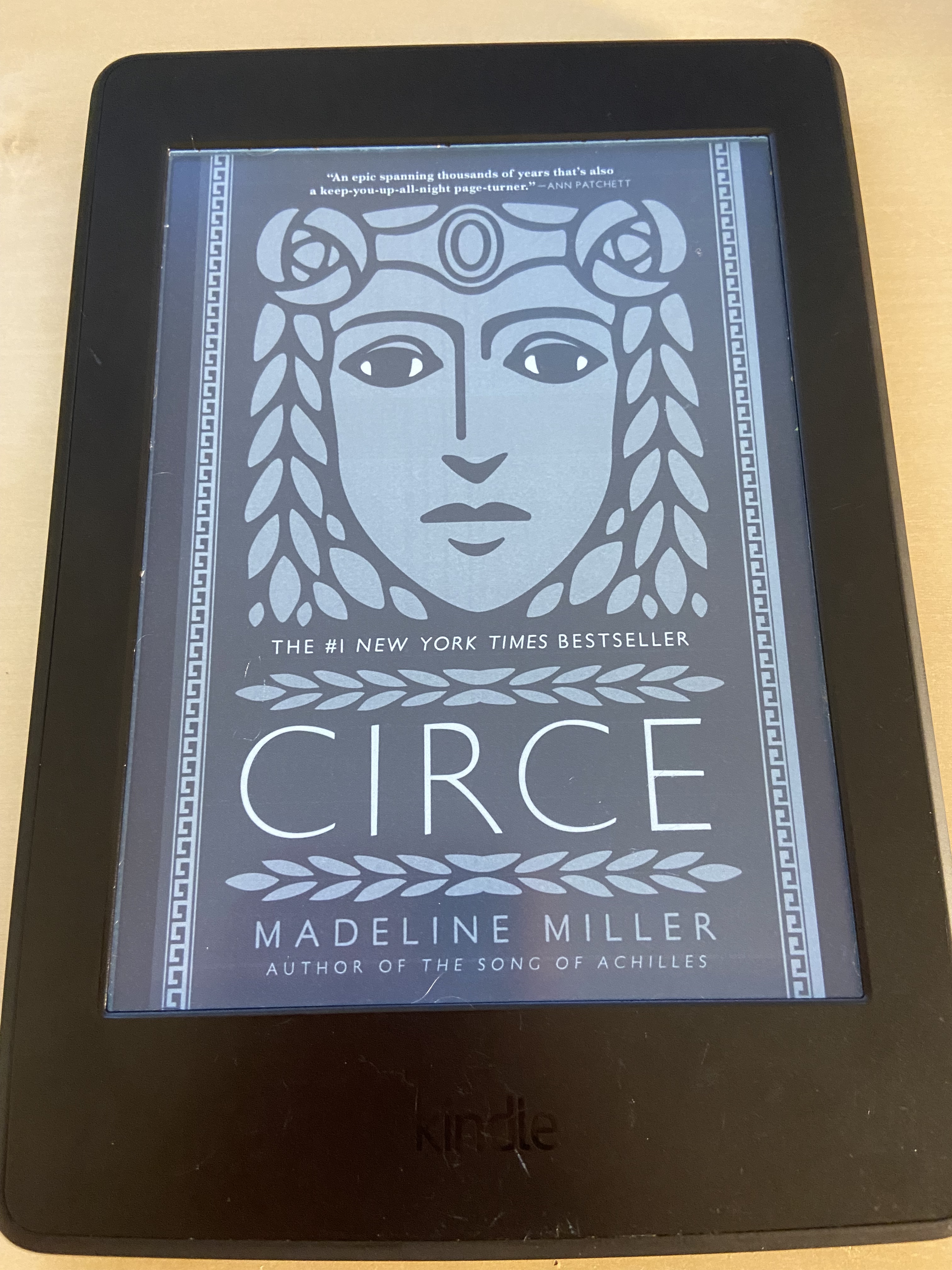
Circe

By Madeline Miller

Published: April 18, 2018

Read August 15, 2021


Circe is a retelling of Greek myths following the demi-goddess Circe, which is why Madeline Miller decided to call the novel about Circe, ahem, Circe.

I haven’t dipped my toe back into Greek mythology in many many travels of the chariot of Helios, so Circe for me was a wonderful return to that world. I love the world building around each of the characters and seeing the fresh (at least to me) perspective on the pantheon of gods, mortals, heroes, and monsters. At the same time I greatly enjoyed the personal stories here. the specific character of Circe really resonated with me in the struggles on what it means to live that I haven’t seen recently. I believe some might add “… as a woman” in some reviews, but I’m not exactly the expert on that particular subject.

As I made my way through the book, I saw the men of Ancient Greek myth weave in and out of Circe’s life as she (mostly) remains on her island.  Hermes, Daedelus, Odysseus, each is a starkly different man interacting with a progressively wiser Circe. In addition, Circe starts the tale being maligned by various outside factors (mostly men) and progressively gets stronger and wiser from those experiences within the book.

The larger myths were on the periphery of my memory from middle school English class as I read. Miller does a wonderful job of retelling these classics through Circe’s own eyes. So many myths are woven in a long life of this woman she has to bear and persevere, whilst events big and small bump up against her relatively solitary life on the island of Aeaea. Not to say Circe doesn’t have agency (she shows this very specifically when it comes to her own children), but the feeling of the book for me was always the tide of life rolling, buffering and shaping, Circe. As life might do to any of us. This quote puts that sentiment to a point, when Circe discusses Odysseus,


“I had no right to claim him, I knew it. But in a solitary life, there are rare moments when another soul dips near yours, as stars once a year brush the earth. Such a constellation was he to me.”


The overall story of the book took the arc of a life well lived, even if ones life is limitless. Events continue to happen to Circe and at some point the book simply stops which took me by surprise. I put some intent behind this but perhaps the mythology simply ran out for Miller. I prefer to see it as, excitement and adventure come in waves, but you will return to your own island and your own chores and prepare for what may come next and battles to be fought. Circe traverses her own life I feel through this book, and although she doesn’t specifically die (spoilers) at the end it ends with reflections on life.


“He does not mean that it does not hurt. He does not mean that we are not frightened. Only that: we are here. This is what it means to swim in the tide, to walk the earth and feel it touch your feet. This is what it means to be alive.”

The Code Breaker

Walter Issacson

Published: March 9, 2021

Read: August 1, 2021


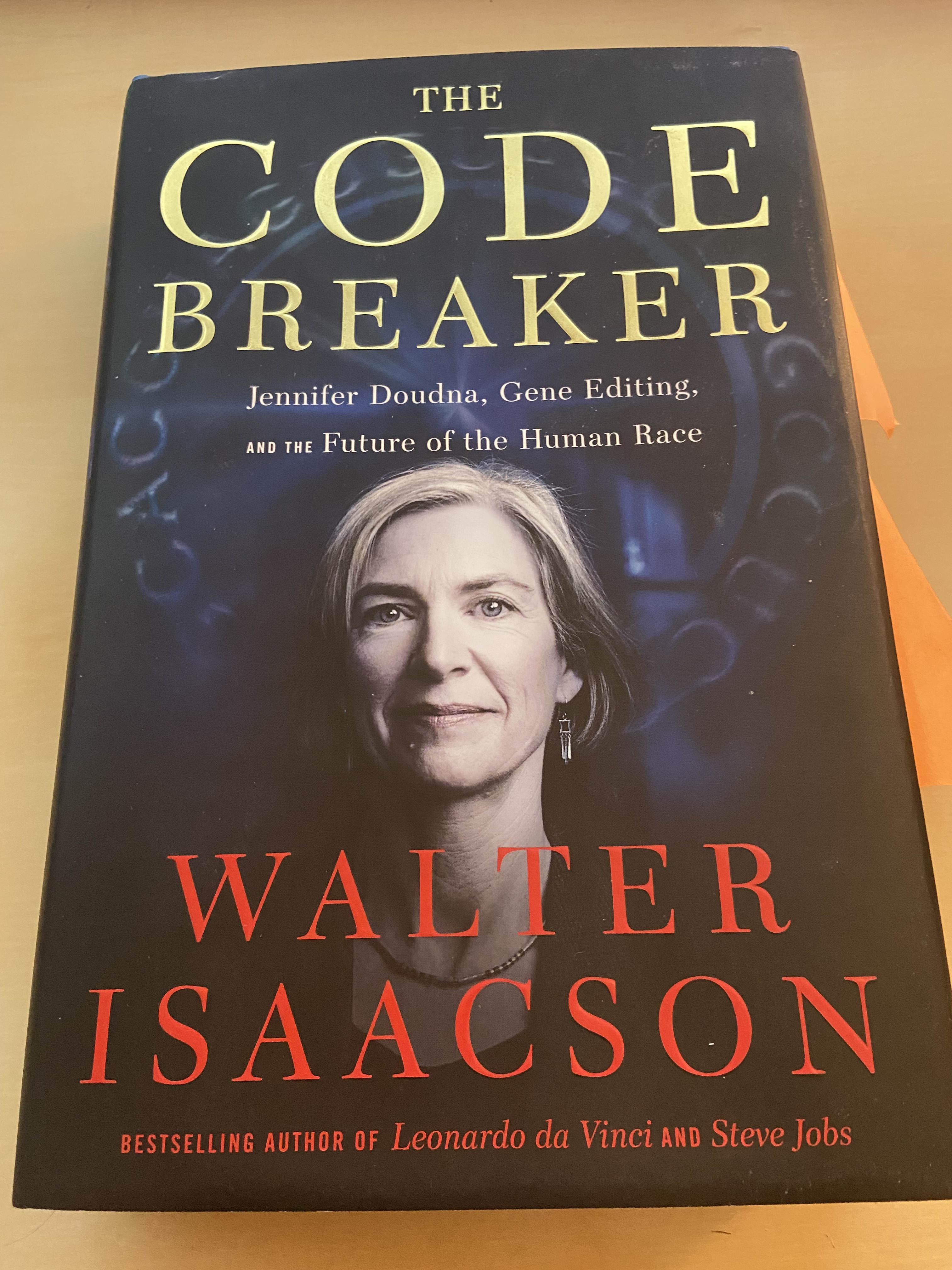
I was looking forward to reading this one. I am, by education and nature, someone who is firmly in the physics camp and not biology at all. Not to mention, someone who usually avoids all things blood, guts or biological. I’m also a man who likes to feel dumb from time to time. I’m most importantly a man who has seen the Ethan Hawke movie Gattaca. So I was excited in reading about genetic engineering, and having Walter Issacson (who’s books on Jobs and Einstein I liked) write it.  This also was the start of my run of physical copy books I bought for a stretch in ’21 after the events of early this year (pictures above taken by yours truly).  A good hardcover has always brought me comfort, even if it becomes a pain as I manage to move between apartments. 

The Code Breaker presents itself on the outset as the story of Jennifer Doudna, an American biochemist who was one of the pioneers of using CRISPR, but ends up including wide cast of characters.  I was a bit surprised, as Doudna’s mentors, mentees, and competitors take center stage for various phases of the book and she disappears for multiple chapters.  When we do follow Doudna, her direct contributions, although scientifically significant, are presented in a way that seem minor or, quite matter of fact.  I would guess this occurred one two ways, one the “miraculous” actions of a previous Issacson subject, Steve Jobs, add more drama to the page, than lobbying for government grants and creating small startups and quickly dissolving them within the medical (genomics) technologies industry.   Doudna as a person just doesn’t have the same cult of personality as jobs so there wasn’t as much to dive into in her own speech or perspectives that wasn’t better suited to putting the community of scientists at the fore. Seems like from the cover and the sub title Doudna was intended to be the main focus before expanding the cast.

This book felt quite light on material.  The color printed photos included are interesting for matching names to faces, but full head shots on single pages felt like they were also there to push the count up to warrant the hardcover size.  Issacson’s also takes pages out of the book (whole chapters actually) proposing thought experiments in genetics as opposed to documenting the scientific state of things or simply quoting other ethicists in the field. Generally, Issacson’s voice is very present in this book to its detriment. Constantly pointing out the possible ramifications of this tech without letting us hear it from the horses mouth. He also may be a bit over worried about losing readers in the technical details and then pauses to hash them over and at least to me it seems unnecessary. I find it odd to think who the audience is that hes trying to placate with this method.

This was a very recently published book on an evolving field as

Gripes aside, I still was happy to have had an introduction to the genomics field and learned many things far outside my wheel house, but I have to think there may have been a better book to do it. As i link below all these people discussed are alive and working in the field today so you can look at who went to what companies and is working on what projects immediately. This is a nice change from reading about many Presidents long dead or fictional characters. I hope that I can find some more books, videos or lectures to help me understand better the field as I see reports in the news.

I don’t want to dive more into the actual here so I’ll just list some personal notes I found interesting.

Random Observations

  • The Germline is the portion of genetic material that you pass onto your offspring as opposed to genes that will not. Some genetic editing debates described in The Code Breaker are centered around crossing the germ line.
  • Doudna’s early work parallels some of the feelings my own path in electronics design engineering
  • “Never do something a thousand other people are doing”
  • Replication of RNA is independent of DNA
  • In scientific publications the first author is the hands on scientist (usually younger or a grad student) and the last author runs the lab the experiment was run in.
  • Genomics made a shift from RNA to DNA editing.
  • Tansopons : jumping genes
  • “phase problem” crystalography
  • This is the second book I read this year that discusses The two-body problem in academics.
  • The dicer enzyme is part of a coronavious the messanger RNA method to develop the rececnt COVID-19 vaccines.
  • There are 92 Cas genes\CRISPR associated enzymes 

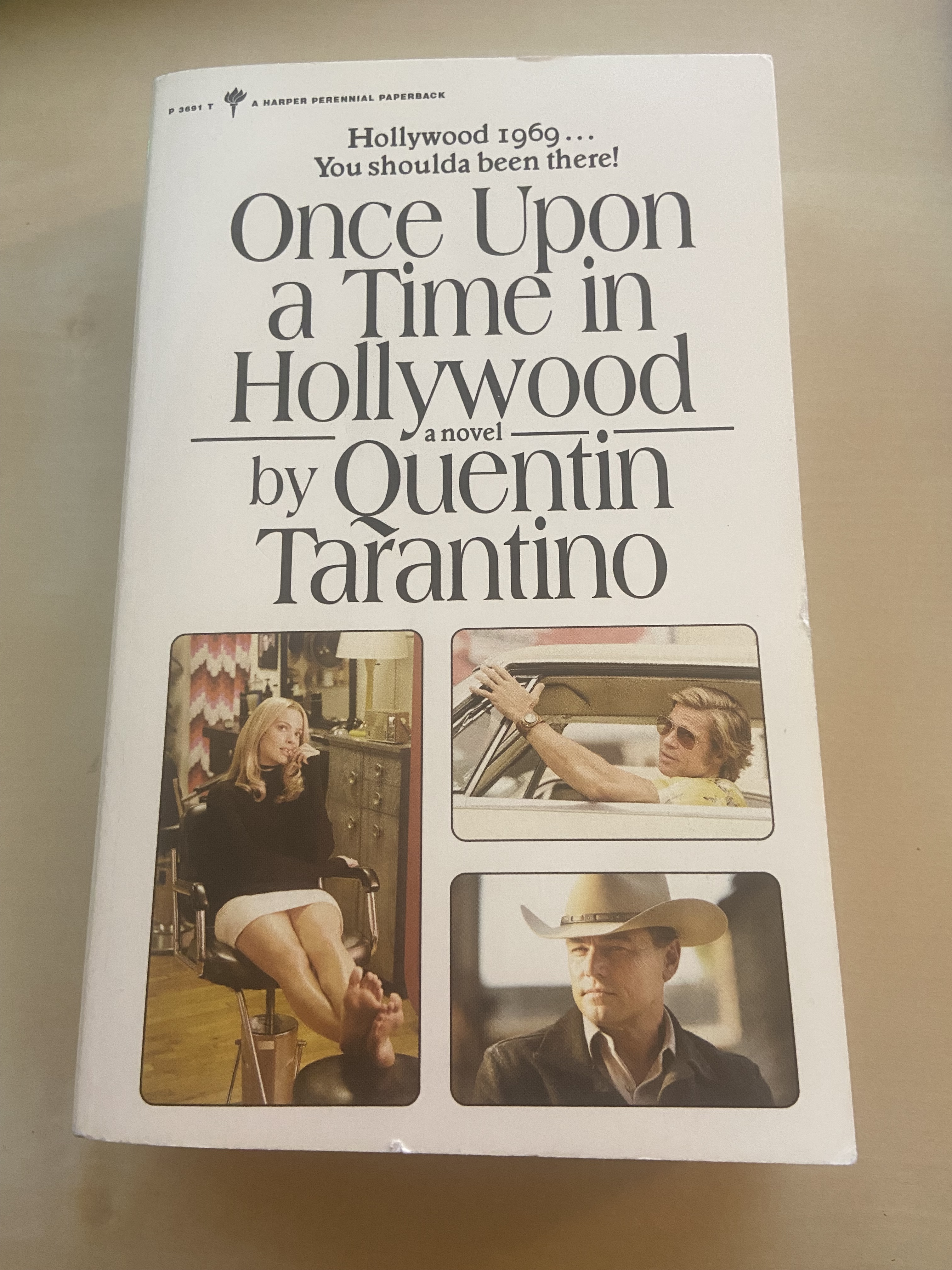
Once Upon a Time in Hollywood

Quentin Tarantino

Written: June 29, 2021

Read: September 3, 2021

Rick thought, I don’t wanna do no Italian movies. I DONT WANNA DO NO FUCKING ITALIAN MOVIES. Rick said.

Quentin Tarantino, Once Upon a Time in Hollywood

Man that Once Upon a Time in Hollywood book is definitely a book for people who love Tarantino and Once Upon a Time in Hollywood specifically.

I enjoyed it greatly.

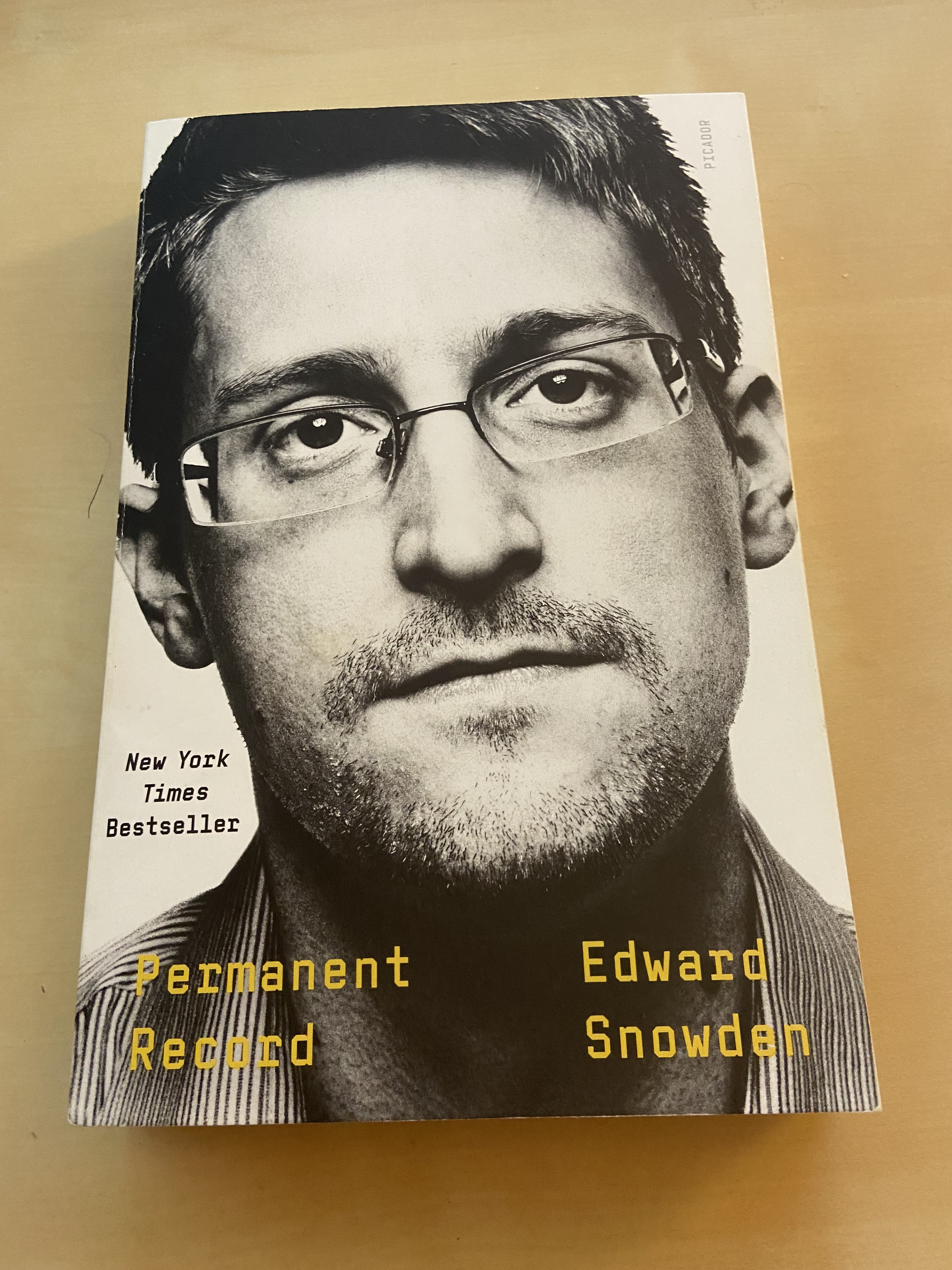
Permanent Record

Edward Snowden

Published: September 17th 2019

Read: June 22, 2021

This was not a well written book.

But more importantly, this also wasn’t a very interesting book.
There were some insights that I liked towards the end which made it entirely enjoyable enough for me.

Edward Snowden’s autobiography spans Snowden’s entire life and is a portrait of a man who seemingly has everything figured out.  This is a man who is trying to put his spin on the story, and build up his own character as a person of moral conviction, a child of civil servants who was instilled in his own mind the need to fundamentally serve his country.  A man who writes about his savant like interaction with computers throughout his childhood. A young man who took a noble stint in the military early on that got him injured,  where he was almost locked in Ft. Meade on 9/11.


This is a very stiffly written account, and unfortunately for me I may have been lead down this path when I saw an online review before finishing Permanent Record about the writing style.  That review managed to take the approach that Ed Snowden portrays himself as the smartest man alive.  Hey did you know, that video games got people into computers? Is just one almost painfully cringey few pages in the book. I suppose what I was looking for from this book was an instruction manual on how to use proper protection when dealing with nefarious denizens of the internet, coupled with the detailed events of how Snowden actually was extricated to Hong Kong where I watched the documentary CitizenFour by Laura Poitras. 


That documentary is much more interesting than this book. Other than a few references to using Signal for end to end encryption, and how in the wake of his actions, Congress has some larger level of awareness of private citizen surveillance than before, many details remain in the last third of the memoir. The material regarding the courts in particular and the methodologies available (or not) through the three branches of government were very enlightening. Specifically the limitations of information getting shared or even reviewed between the Legislature and the Judiciary. The interactions between Wikileaks and Snowden were very intriguing as well as the interactions between Ed and the Russian government.  I have nothing to base this on but the interactions with the Russians seems to be somewhat glossed over from what actually occurred, but that might be attributable to Snowden’s writing style.

One part that fascinated me was how did Ed managed to get his girlfriend to stick with him through this whole series of events. The way he tells it they were on the rocks to begin with and actually seemed to be totally broken up and then through some mysterious ways she extricates herself to Moscow with Snowden to get married and live their limbo criminal life. His efforts early on at metaphor approach my own sophistication when making some vague references to the Pantheon of Olympic gods to the intelligence community.

I don’t know Snowden, but he writes like any sort of anti-social nerd I’ve met throughout my life.  The tone becomes a bit grating because observations and deductions are stated as fact occurring a priori to Ed.  He’s the smart guy so it occurred to him to re purpose an old computer to make copies of programs from STELLARWIND or what have you.  Its also quite funny at bits.  Like the idea that in theory all program names are supposed to be random but that rule is constantly broken to get people having interesting sounding projects to work on. Alas, Permanent Record could have used more of this for me and less diatribes into Mario’s parallels to the information state.

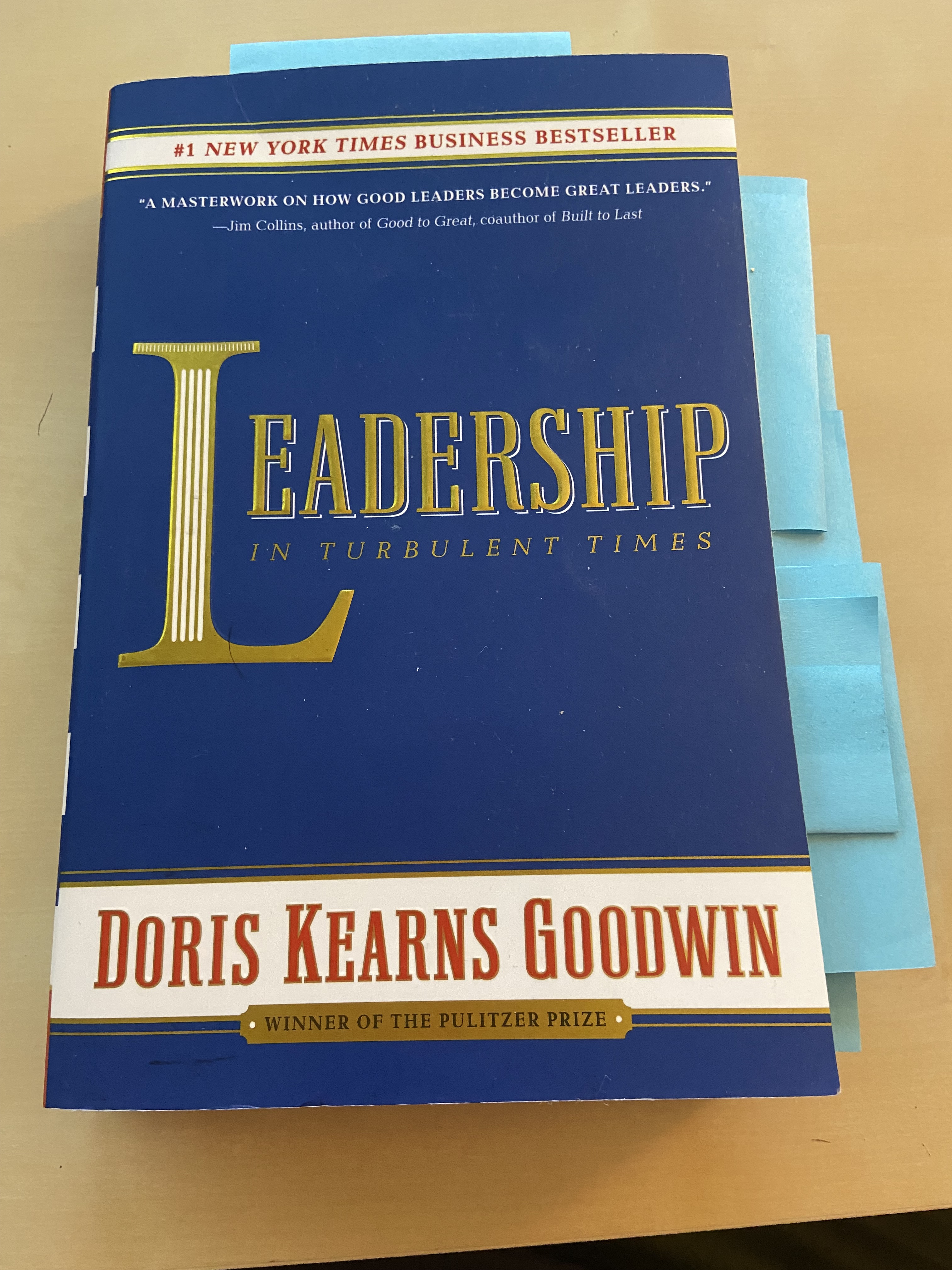
Leadership: In Turbulent Times

Doris Kearns Goodwin

Published: September 18, 2018

Read: May 29, 2021

To be honest, I read this book to see how I stacked up to presidents.  Its not flattering to admit. Until the events of 2020 I had a low regard for presidential or any leadership.  


At some point the human at the top is irrelevant, right? The process and system (checks and balances) put into place supersedes anything that a single actor man can do.  Public polls, the press and the gossip feedback loop of the 24 hour news cycle (featuring twitter) and perpetual internet click bait had me convinced of the lack of agency or impact leaders actually have.

 
At some point during the COVID-19 pandemic, observing a leader focusing intently on proving his critics wrong and maintaining a winning argument, in contrast to attempting to create some connection with the millions watching him on the screen my mind changed. I found myself realizing that perhaps not legislatively but psychic a leader of men must represent those men and there is value to that psychic collective as opposed to just the nuts and bolts of legislation. No matter how large the organization there is calm, or direction, or purpose that can be put into one man who can make a difference.  Coming out of Leadership in Turbulent Times helped me in this regard.

Goodwin separates the portions of the book into the phases of each Presidents career rather than making a section on a single man. The early years, middle phase, and presidential leadership principles are hit for each man.  I presume that much of the material discussed here was already covered in her other books, but based on my remembrances of reading 40 pages of Team of Rivals in 2010,  the Lincoln material at least seems to be reaching further back in time that what that books focus was.  This time phasing of each of the men really is straddling to see how each dealt through phases of their own life.  From early days to the peak of their presidential contributions to leadership and then their post presidential years.

Goodwin frames Leadership as a guiding framework or case study more than a direct history.  Digging further into the working mental modes of each of the presidents and highlighting their differing personalities which is shown more in the early years and reinforced later.  Lincoln comes off as a massive depressive who is willing to experiment and shift his positions as he and the country developed.  Teddy Roosevelt singular focus on engaging with the large beasts whether they were physical or metaphorical. Franklin Delano Roosevelt smiling and laughing with his friends and as his body failed him. Lyndon Johnson working frantically through his life from being an educator to a politician.

Now I’ll write about me again! What is my own leadership style? To grab something and polish it until it’s fit to spit back out. Like Lincoln with the hard piece of metal slowly scratching into it until its bound to the memory for all time. Or am I more Johnson-esque “freeze out”,  showering co workers with affection and assuming performance and loyalty until that fades and then I withdraw entirely.  After reading this book, I would like to be a badass like Teddy Roosevelt, LBJ makes me feel like i don’t work hard enough, Lincoln would be just as depressed as i was and we wouldn’t have any fun, and FDR isn’t someone I want to hang out with no matter how much he lead America through a trying time.

Interesting to note that each of the presidents were connected to the previous in a way. Roosevelt used Lincoln numerous times as a basis, FDR as Theodore as well and Johnson was directly the protege of FDR going forward.

Yet the core of the book is an examination of four men who just happened to be president and analyzing how they dealt with the needs of the office with different strategies.
Self help has run dry for me in my 30s so perhaps history can help


What is well-spoken must be yoked to what is well-thought. And such thought is the product of great labor, “the drudgery of the law”. Without that labor, without that drudgery the most eloquent words lack gravity and power”

Abraham Lincoln


“A second class intellect but a first class temperament”

Supreme Court Justice Oliver Wendell Holmes Jr. About Franklin Delano Roosevelt


” Do what you can, with what you have, where you are.”

Theodore Roosevelt


“You have to realize that a politician -a good one – is a strange duck”-

Lyndon Johnson