Travels with Charley: In Search of America

John Steinbeck

Published: 1962

Read: June 4, 2021

So I set off to read a travelogue by a novelist dead for 52 years in the year 2021.  The year where many across the world are longing to get to a new locale apart from their own work at home tombs.  Perhaps that opinion is only from just those of us who are sick of staring at the same four walls in this time of the pandemic, no matter.  John Steinbeck is a man from a different age.  He wrote Travels with Charley as a road trip memoir of a man, his dog, and his converted pickup camper.  And so, Casual drinking with strangers, lamenting the changing country and prevalence of freeways ensues.  Even with the salt of the earth topics, Steinbeck polishes his words to be profound and literary, but to my eye this is the voice of man long dead and who seems familiar.  While reading this book I kept thinking whether my grandfather as a younger man would have had the Steinbeck sensibility.  As described in Travels with Charley, Steinbeck was a veteran of World War II who was struggling to finish The Rise and Fall of the Third Reich. For days after, I wondered if he ever managed to finish the book or if that even mattered.


I should point out, the Charley in the title refers to Steinbeck’s pet poodle who accompanied Steinbeck throughout a traversal of the country. The travels, were a pleasant sepia-tone of a time a surprising long time ago told by a man who wasn’t engaged in the summer of love but was looking over his middle age and pushing into his own end. A man who styles himself as Don Quixote with his pickup truck christened the Rocinante.  This book is a time capsule who parallels today are uncanny and Steinbeck was a man who talked seriously and then took him self to be a fool clearly.  When lamenting on pasteurization he ends the argument with this

 
“The lines of change are down. we or at least I, can have no conception of human life and human thoughts in a hundred years or fifty years.  Perhaps my greatest wisdom is the knowledge that I do not know.  The sad ones are those who waste their energy in try to hold it back for they can only feel bitterness in loss and no joy in gain”


Steinbeck also comments on the nature of vaccine mandates which gave me a chuckle from here in 2021. Once he is trying to travel across the border into Canada he gets interrogated by the official at the border for charlies rabies shot. In this instance, Steinbeck shows me at least he is a rugged individual who is smart enough to know when to draw the line.

  
“And it is usually so with governments- not a fact but a small slip of paper”


” For this reason I cannot commend this account as an America that you will find. SO much there is to see, but our morning eyes describe a different world than do our afternoon eyes, and surely our wearied evening eyes can report only a weary evening world” 


There is some controversy (I googled) on this book of whether the events are true. I’m not entirely sure that this matters to my reading of the book or me as I got at least one mans view of the country in an older time and got some beautiful prose.  In any case as Steinbeck admits, the journey was a bit more of an idea than an actual experience held to plan.  As i look back through my highlights i find again no events that are worth pointing out but more the internal monologues of the man with the vision of a sleeping bag and a bottle of whiskey in the back of a pickup truck sleeping next to a dog.  


Many quotes nicely sit with as i read them and look back now, I hope I can keep it handy in the future for a sounding board on life. A book I thoroughly enjoyed reading in these times as a teleportation to a time and prose that felt warm and comforting if not a bit alien.


“I find this interesting, but it does make for suspicion of history as a record of reality”

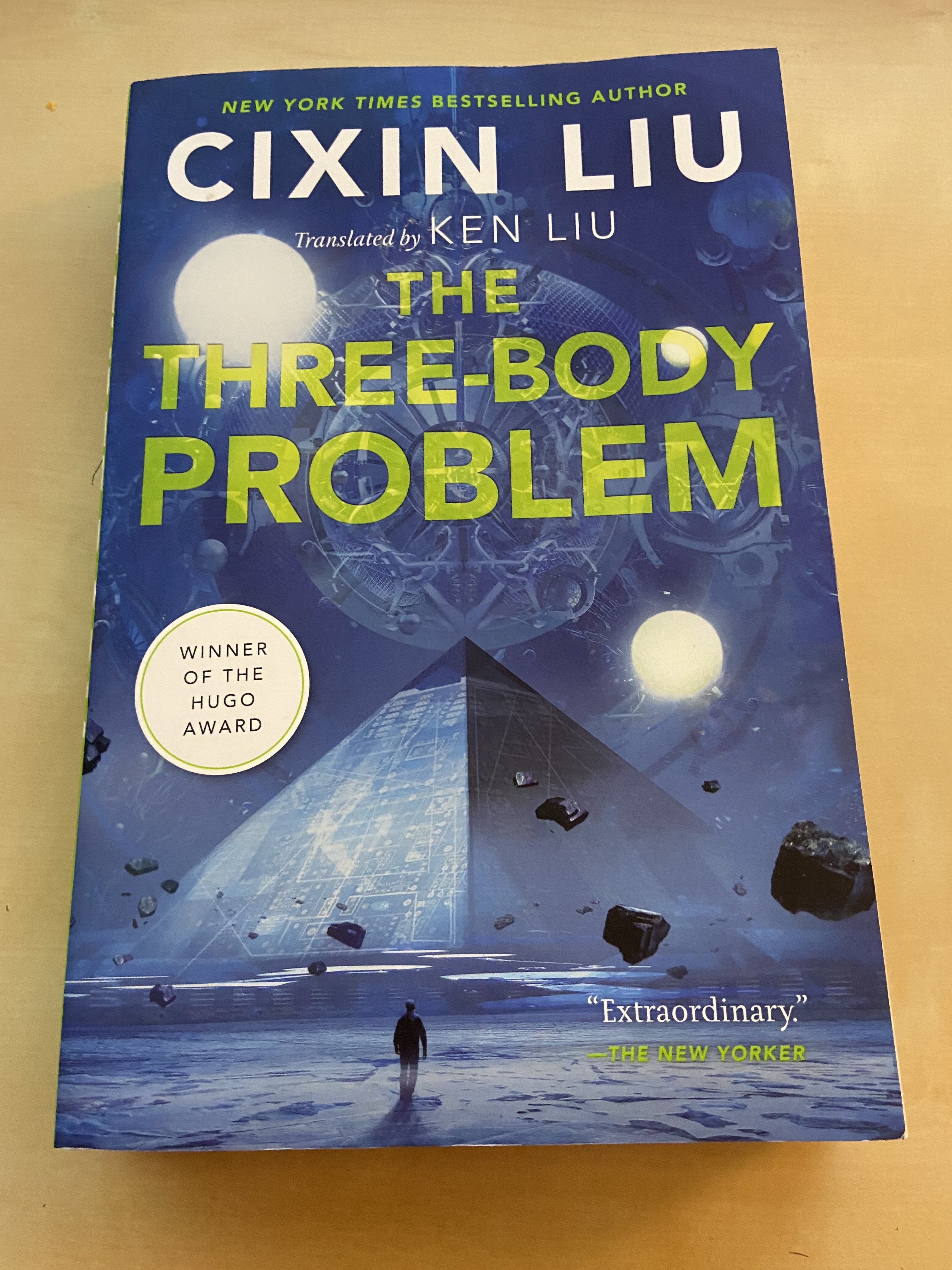
The Three Body Problem

Liu Cixin

Published: November 11, 2014

Read: April 12, 2021

The Three Body problem is the first science fiction novel I’ve read in some time.  The last one I dove into reading was the Peter F. Hamilton Commonwealth Saga, which was some sprawling epic of 2000+ pages between two parts, this book is not as long and not nearly as sweeping, but has such a different view on sci-fi than I’ve seen the past.


The Three Body Problem
struck me on two fronts.  One, the hard science fiction elements. The three body problem itself I was unaware of (and should turn in my science card). It describes how in a system of two bodies and their gravitational interactions the orbits can be calulated in a straightforward manner, but when three bodies are involved the system is so chaotic that it cannot be calculated and predicted without an extreme level of mathematics.

The second notable aspect was the Chinese perspective that pervades the novel. This being in direct contrast to much of the sci-fi and any novels i have read in my adult life which now that i think on it must have been written by Brits or Americans in the 1960’s.  Historical figures from Chinese history make appearances and I’m sad to say without the footnotes I would have had no idea who they were. The cast of characters acts quite alien to me at times but I take at least a part of this writing style to be from being translated from Chinese and having the actions of non American culture at play. Apart from aspects I assume to be Chinese the writing style is quite interesting. The secondary characters are all very stereotypical (corrupt detective with cigar, overly serious general) and at a certain point the “main character” exits the plot and is replaced with another character. There are sequels to the book so perhaps this is addressed somewhere else.

The narrative bobs and weaves between characters ultimately effected by the influence of the unseen but heavily influential Trisolaris society, and although a few threads and characters are brought in. Ultimately the story coalesces upon one character Ye Wenjie.  a woman who is shaped fundamentally from coming to age amidst the Cultural Revolution of China and (perhaps) dooms humanity based on her own view of it.  

Lincoln in the Bardo

George Saunders

Written: February 14, 2017

Read: March 28, 2021

As I started with this review, I thought that I should transcribe some quotes here, but ultimately I decided each individual quote taken just in a vacuum would just diminish the impact they had within this novel.  Lincoln in the Bardo is a surreal experience that plays with language and reality and transcending death. Which made it Jake’s beach read pick for the year.

Firstly, I didn’t like this book nearly as much as the short stories i read of Saunders after i read this (I’m writing this review in November 2021).  This book can best be described by me as a meditation.  Various characters are tent-poles of the many ways to live and what level of I suppose penance you need to pay to reconcile your past and become something beyond your life.  Oh and yes, this story does include President Abraham Lincoln.


Without spoiling much, the book is written so different characters change different prose styles which gives this novel a short story collection within a larger arc structure.  Its a novel of death primarily and a story of ghosts( or ghostly people or spirits or something else) grappling with their lives and moving towards some other afterlife.  It has a fantasy pastiche mashed into eastern religion. It left me somewhat unsatisfied but entertained and with a few more ideas floating around. I also am a person who has both prayed and meditated and considered the boundary between the two at the personal level over the years, so I may just not be as open to seeing this as fundamentally new. This is in contrast to when I read Siddartha by Herman Hesse a few years back which did give me a new perspective.

Ok I give up, I’ll put this quote here, this is probably better than any more commentary I can give:


“Tying a shoe; tying a knot on a package; a mouth on yours; a hand on yours; the ending of the day; the beginning of the day; the feeling that there will always be a day ahead. Goodbye, I must now say goodbye to all of it.”

This section comes towards the end of the novel and really gets to one of the core issues (or perhaps a core feature) of Lincoln in the Bardo. Ultimately this book should be read aloud, and towards having someone else read it and talk about, even if the impact it had was not new territory for me. 

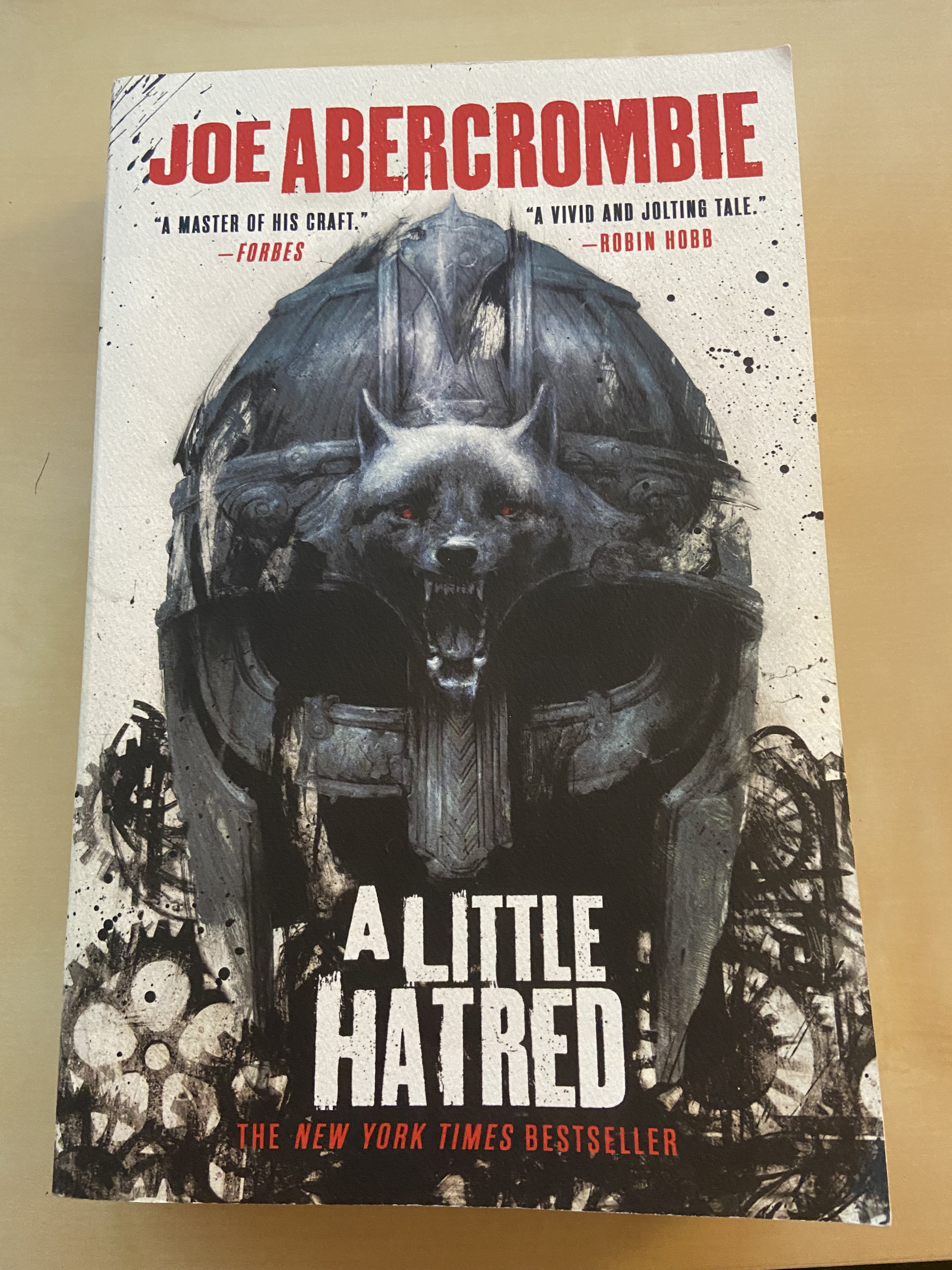
A Little Hatred

By: Joe Abercrombie

Published: September 17, 2019

Read: February 28, 2021

“A leader worth a damn ever, led from the front.”  

Joe Abercrombie is building a world, a dark, sexy bloody, corrupt, crass, fantasy world. With A Little Hatred that world is moving from its Fellowship of the Ring phase from his First Law trilogy into its Gangs of New York adolescence. A Little Hatred builds on the issues seen in The First Law and pushes them into this new age with a new age of industrialization with a new generation of characters. My initial feelings of excitement of something new reading A Little Hatred faded over time into a familiar feeling of Abercrombie’s previous works.

The two sections of the main plot brought two goals. One is of the “get you up to speed” theme new flavors of characters with subtle repetitions of notes from the past. The characterizations of Savine, and Bull Broad are utterly fantastic. At first, I assumed parallels with characters from the First Law trilogy, Logan and Superior Glotka but ultimately these characters are their own. Savine is the daughter of a conniving Arch Lector who has used those skills to become a cunning dust snorting entrepreneur. Bull broad is a ex soldier who spends a lot of energy trying to not murder people when he returns from battle. In Abercrombie fashion the more we see them the more unsettling things happen to them as we move through the story.  The trials of Prince Orso, son of the king, are intriguing but ultimately are shades of the issues his father had to deal with, although he is a very different man than Jezel who we also knew from the last books as a young man.  Ultimately, he may make still a better king than Jezel did despite the omnipresence of Bayaz, the ageless wizard who is constantly pulling the strings here. 

A highlight for me was the appearance of the Breakers and the Burners as a contrast from the established utterly corrupt central Royal Government. Both groups are revolutionaries trying to counteract the momentum of the Kingdom of Adua moving into the industrial age. The peasantry of old are changing into factory workers and are treated more like garbage as industrialization ramps up.  So the Breakers cleverly decide to Break the machines of industry The Burners are in the same camp but the distinction is instead of Breaking machines the Burner sect decides its totally fine to burn down the entire factory and segments of the neighborhood to try to counteract the corruption of the government.

There are two love story subplots in this book, and each left me wanting a bit more.  I suppose its likely to happen that two smart beautiful women (even if one is a “savage” northerner) interested in men of power and being captivating in their own right would be swapped but the idea that it happened in the way it did just stinks of sitcom-esque writing. It also seems this book had more sexual intruige than in the past books Ive read from Abercrombie.  Perhaps its just me and before I just blew through the scenes or maybe this is the first book where characters have been in comfortable enough circumstances to actually have sex. It could also be attributed to the fact that there are more female leads in the book (which should not be connected). The closest I remember from the first trilogy was Logen and … and Jezel and Ardee at one point but it didn’t seem to have the same impact or urgency that Rikke, Savine and Leo have.   Speaking of sexuality there’s a slight nod to Leo’s friend Jorgenholm being gay I suppose and maybe Leo being Bi himself?  At a minimum having mommy issues tangled up with his sexual proclivities as (I believe) three times in the book he internally pontificates whether he likes women as much as he does before he sleeps with them.  This all leads to quite the dramatic climax (pun intended) and perhaps some major eye rolling.

Overall, A Little Hatred brought the plot and the characters but was quite striking to me the level of political intrigue that can be put into a fantasy novel.

Random Observations

  • I have skipped right from Last Argument of Kings (Abercrombies last trilogy) into this book directly without doing any of the four (?) interstitial standalone novels.  I liked the idea of the time jump but I have a sinking suspicion that hints are being dropped that I should be picking up.
  • In specific it seems that Lady Brock, Bremer Van Dorst, and the queen all have their own machinations already in motion at the beginning of the novel, on that I’m not really privy to, but that may be the hidden reward of diving backwards into the other books. So many fantasy novels so little time.
  • Gorst is supposedly a dueling master close to Savine and Glotka but as Leo notes within the end of the book. He has a very high feminine voice not linked to Leos initial impression of the man. It sticks with Leo. The man was also the same knight who Jezel defeated in the contest with Bayaz’s help.  Maybe this is relevant, maybe not.

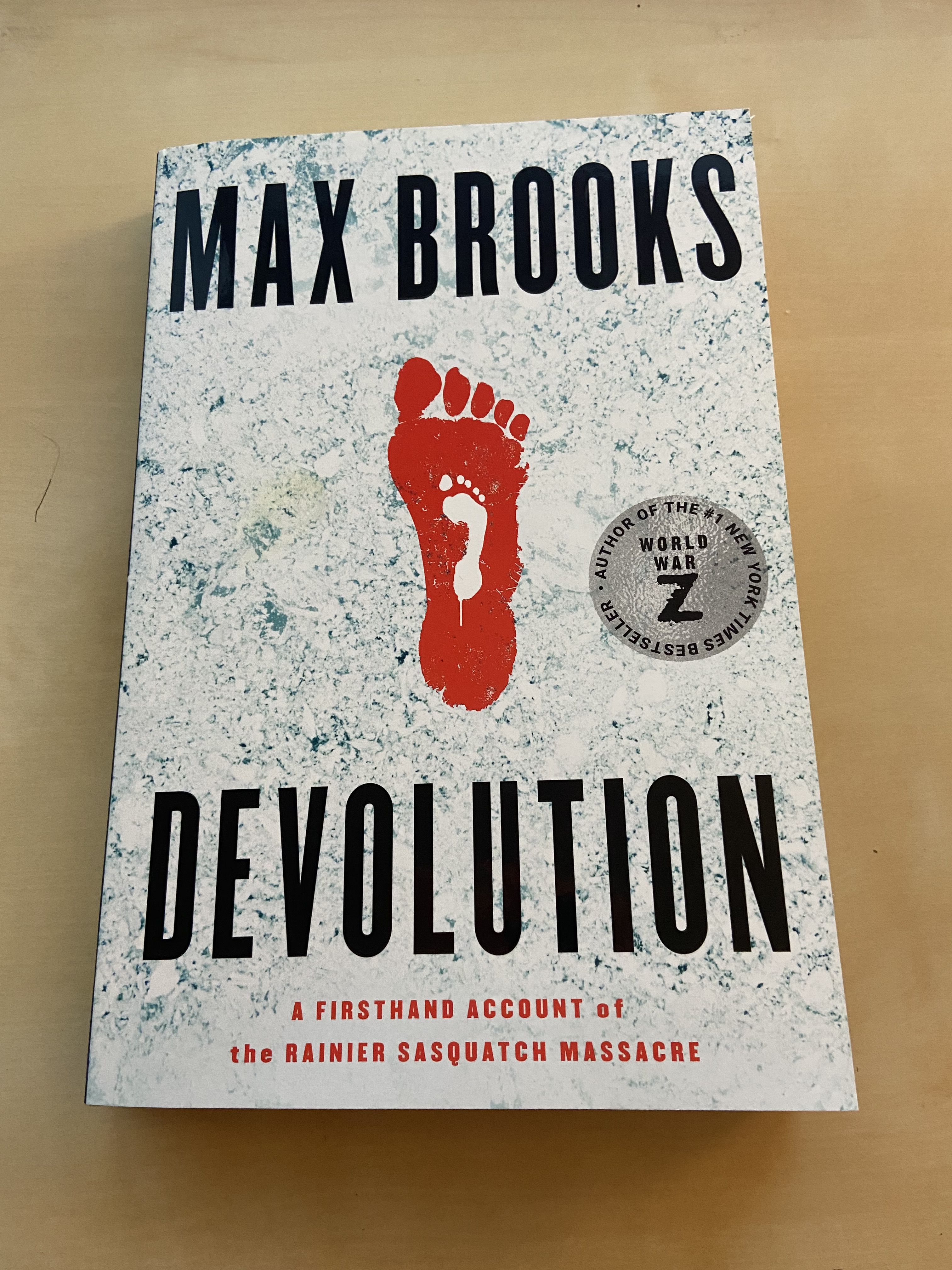
Devolution

by Max Brooks

Published:  June 16th 2020

Read: August 21, 2021 

   
This is a book about Bigfoot. Or should i say “Bigfoots”, plural.  I was pushing for heavier stuff earlier in this year and Devolution was a nice distraction from that. 

A story of a group of Silicon Valley yuppies who dream to live off the grid up in the mountains around Washington in a totally self sustaining green neighborhood. Supplies are flown in via drone drops to ensure everyone can unplug while being fully stocked with all sorts of fancy organic foods.  Suddenly a local mountain, Mount Rainier, erupts and causes the town of Greenloop from the to become isolated from the rest of the world. As luck would have it the same eruption awakens a group of Bigfoot monsters who proceed to attack the town.  What proceeds is a lot of blood turmoil politics and ingenuity from a group in a classic horror story setup. You’ve got the underestimated old woman, the directionless schlub who gets his act together in the face of people getting torn into pieces, and the over confident Executive who may or may not be getting torn into pieces. Devolution was a fun romp that i thought to my self should have been a quick B movie or a TV show. After doing a modicum of google research i realized the story was exactly that but reworked into a book when the project couldn’t be produced.  The story is overall fairly fun and just a touch topical in the setup.   I do have a gripe that the title “Devolution” means absolutely nothing in the context of the story, and the footprint motif is even more confusing. I was rallying for some sort of story that humans “devolved” into apes but alas all this devolution could bring was Bigfoot mania.

Seveneves

By: Neal Stephenson

Published: May 19, 2015

Read: 11/7/2021

It took me a few years to finish this book. I started it back in 2016 and abandoned it with the comment of “ sometimes when struggling with an intense day of electronics work reading a fictionalized account of an engineers design flaw in an asteroid mining robot may keep me from relaxing”. Now at the end of 2021 and a bevy of other more grounded books and frankly less electronics design in my daily life, I was ready to return to this math problem disguised as a novel.


One thing to note is that I did audio and print on this one and I think this is honestly the only way I’ve gotten through any of Stephenson’s novels or any long novel in recent memory. The amount of time I dedicate to reading is not nearly enough to finish these tomes in a month or so sitting which I like to do and I have yet to find a book where I’m comfortable or enjoy putting it down and forgetting the first half while I push through to the ending. This is the only way I could possibly finish this thing in the course of four weeks while riding the stationary bike and the occasional Sunday absorbed into Stephenson’s orbital mechanics diatribes. I did ask myself while reading this book who it was for. I know there are many mechanical engineers out there who would love it but how many normal citizens would really sit through these passages. No matter, onto the book.


Seveneves is split into two parts, the first half being a high stakes extra orbital drama after the Moon simply breaks apart. Stephenson is very clear that the book does not attempt to get to how or what caused that separation, his characters refer to “The Agent” of the moons discussion fairly briefly, because more pressing matters begin to arise. Namely the parts of the moon that are breaking apart in orbit with the earth begin to collide in an exponential rate and will eventually encase the earth in a particle cloud, after bombarding the planet excessively, this event is referred to as the “white sky”. This cloud of particles will ensure that no living creatures can survive on the surface of the earth any longer.


This precipitates a space race to get as many people as possible into orbit around earth to survive. The beginnings of this earth outpost start with the international space station and are built upon by a modular spaceship design designated as “Arklets” . Each of these can be connected or separated with the idea that each situation might be ideal for the realities of space flight. This section also deals heavily with the mission of one asteroid mining executive who believes wholeheartedly that the humans remaining within earth orbit are royally screwed without additional water reserves. In this point he goes to retrieve a giant icy comet fragment and manages to secure that at sever risk to himself and other compatriots.
To describe the amount of things that can go perilously wrong in establishing a permanent civilization today in orbit around the planet are numerous to describe but Stephenson does a wonderful job here of making this entire section of the book non stop issue after issue. Apart from the water reserves you have random micrometeorite impacts, radiation destroying electronics, slowly drifting into the atmosphere which is expanding as the earth heats up after being bombarded with moon particles, the politics of who got to survive and what should be the structure of the new society if species ending events would ever cease, a bargain of whether or not to stay in orbit or run to mars, how to kill someone in zero g, and the necessity of cannibalism to say the least.

At this point mentioning anything in the second half would be a spoiler so if you are interested in any of these topics please read Seveneves so we can chat about some of these sections in length and draw the orbital paths of the ISS and whether or not creating electro-mechanical whips to move people through space is a better idea than solid state rocket boosters, if not then I’m so happy that your social life is much more engaging than my own.


The significance title of the novel is brought to light only after say 550 pages in where the remaining 8 survivors of the human race are all women albeit one who is no longer able to have children. This section specifically ties nicely with my recent reading of The Code Breaker and the ramifications of utilizing gene sequencing technology. As the eight are huddled together safely nestled into a cold notch within a large piece of the former moon they look to the future of humanity. And they have a space genetics lab and the digital library of DNA of every living species on the planet including humans. They decide collectively that each woman has the right to alter one aspect of their offspring in this time and hence they guide the course of the human race into seven separate races of humans, each with their own characteristics.


At this point the novel jumps 5000 years in the future after these seven races have expanded out from that small rock into an orbiting ring around the planet. Terraforming is proceeding on earth to try to make the planet livable again and there are a two teams setup within the society simply placed as red versus blue. I will stop here because I took about a week off between these two parts as you could actually in my mind have two entirely independent books or maybe a whole series based on this second half. Stephenson seems to be playing with the idea of fantasy races, one race optimizes for physical strength and muscle mass, one for leadership qualities, one for intellect, one for charisma and deception, etc… The rough bit here was the premise that I had a really good feel for most of the characters in the first half. I was very close to Dinah (bold adventurer type), Ivy (cool headed leader type), Tekla (Russian badass fighter type), but as opposed to the scheming former president Julia the other four were just a blur to me and it didn’t impact as hard as it could have.
Then again many pages were spent on this book and I think there is something to be said for finishing an idea and getting it out there rather than making a series and stretching these things to their limit.Stephenson does (in a positive way) the minimum to get his point across and pulls the rip cord and moves on. Not to mention is dubious whether the characters are really the point here or just the high level stuff. Orbital mechanics, how to evacuate the planet, how to restart humanity. These seem to be his priority, I only wonder if someone was to write a whole series of books in the later setting what stories could be told of the people living there and dealing with it.


No matter what evolves is a quest of old where each race of human is represented to go on a mysterious quest into the frontiers of the earth and see whats going on. There’s a bit of hand waving here (or maybe I was tired when reading) about why they are actually going on the journey, whats in it for each of the members and what the real goal was before the events actually transpire, but to put it shortly (which Stephenson does not) the section culminates into discovering that there are actually other humans who survived both under the ground of the earth “the diggers” as well as under the sea people “the pingers” who descended from a group of military officers who originally were stuck in a submarine at the time of the white sky. There’s again a lot that isn’t really explained because that wasn’t the point of the novel about how exactly both of these groups survived, but the contrast is between what we have followed in the “spacers” journey of the seven eves as opposed to these other two parallel societies. To me it Seveneves thoughts on humanity is to take it at face value, it is imperfect and each society has their own ways of trying to make the whole thing work, conflict is inevitable and eminent domain issues are always the toughest ones to muster. There are some allusions I think overtly or not so with regards to the diggers use of bows and arrows and the native Americans.


Ultimately the book ends with these groups making alliances and formally understanding their cousin species are out there, but nothing is written and nothing is easy. Again Seveneves seems like two books to me that could each stand on their own but the second half seems to warrant much more development rather than a wisp of a plot pulled together in order to write an analysis of what else may happen to humans in a 5000 year span.

5000 years. A span of time I thought I could wrap my head around.

Here are a timeline milestones in the last 5000 for you:

  • 5000 years ago: First use of a solar calendar of 365 days
  • 4000 years ago: Earliest abacus and use of coal, decline of the Bronze age civilizations in Egypt Greece and Mesopotamia
  • 3000 years ago Start of the Iron Age, iron replacing bronze for tools and weapons
  • 2000 years ago: Rise of the Roman empire.
  • 1000 years ago: The Crusades, windmills paper money
The Blade Itself

Joe Abercrombie

I’ve been delving backwards a lot lately. Soaking up old music from the smashing pumpkins and Zwan, re watching Community for the first time since I was in high school. With all the perpetual posturing and chaos around us bombarding our daily lives I am searching for common comforts. Before I started this book I was deciding between the Dresden files (another property I haven’t read but have seen the adaptation on TV) or The Blade itself. I didn’t realize this book in a way was so similar to a title I had already read, Game of thrones.

This book is high fantasy that has many notes of GRRM. An empire in denial of a growing threat. A vast world of which we get a snapshot of the castle. Magic thought to be a myth to those in power versus reality. The king here is all but a puppet which George In his pursuit of Westeros never managed to push as an idea.

Abercrombie paints the kingdom and capital as Adua. The pace here is at a high clip and left me not knowing how much actual time we received with any characters. Noiy here the book does have what I consider a bloody climax to the violence with the Bloody Nine Logen making a proper introduction as his Jekyll and Hyde combination. This come far enough into the book to strike intrigue but not give any satisfying answers. Much of the book is strung along by the reader not quite understanding the over arching plot and being pulled by the first magus as the characters are. I’ve always been a fan of how these universe evolve through what we see and Abercrombie does a great job of that.

The detective story of Glotka is wonderfully woven through this volume as he struggles and fails to uncover Bayaz as a fraud. The slow unveiling that essentially the inquisition is a crooked policing force and the intricacies around coerced confessions really set the violent tone for the book some others have noted.

One weak spot was the introduction later into the book of Ferro. I had a hard time visualizing the woman or what her value was for a bit. Unlike Logen, she had a lot less runway of story before getting to the capital so I can understand the placement here but putting here up further to break up some of the first part may have been more engaging. Yet just as likely another character joining the fellowship may have caused my head to spin further than it already had.

This book ends with the formation of a fellowship secretly sanctioned by the government whether to keep the chaos of the Magus out of the public eye or really because of the public good, I am not sure. Also as noted the role of Jezal is unclear in this merry band apart from the idea that Bayas may be able to elevate him to that of a phenomenally brave fighter over his brash self. The Blade itself has me wondering again if the tone of the original fellowship had such a tone. Instead of that of endorsement and support of an unlikely quest.

I was expecting the sin city of fantasy novels and I suppose in a way I got what I thought.