Liu Cixin
Published: November 11, 2014
Read: April 12, 2021
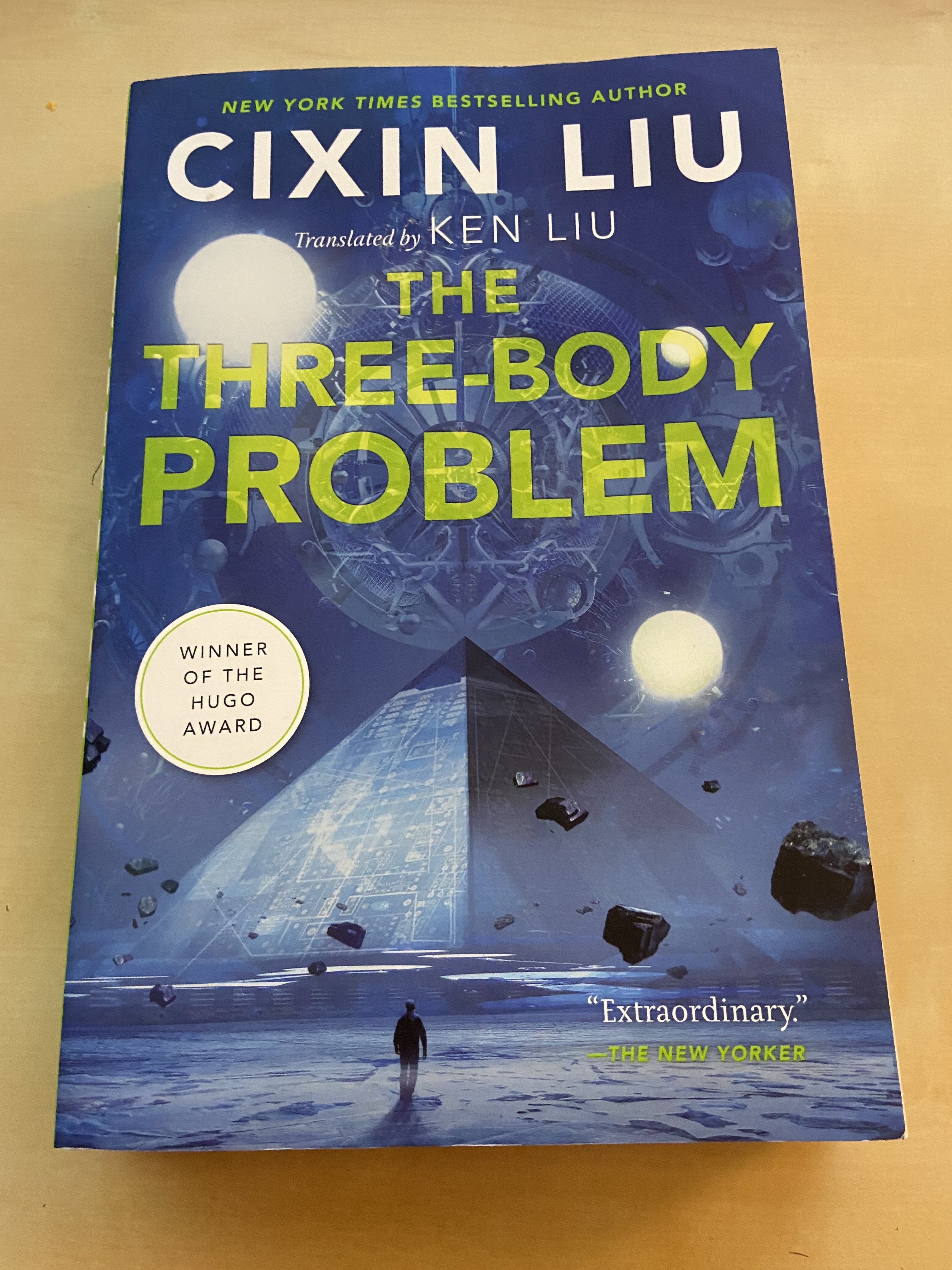
The Three Body problem is the first science fiction novel I’ve read in some time. The last one I dove into reading was the Peter F. Hamilton Commonwealth Saga, which was some sprawling epic of 2000+ pages between two parts, this book is not as long and not nearly as sweeping, but has such a different view on sci-fi than I’ve seen the past.
The Three Body Problem struck me on two fronts. One, the hard science fiction elements. The three body problem itself I was unaware of (and should turn in my science card). It describes how in a system of two bodies and their gravitational interactions the orbits can be calulated in a straightforward manner, but when three bodies are involved the system is so chaotic that it cannot be calculated and predicted without an extreme level of mathematics.
The second notable aspect was the Chinese perspective that pervades the novel. This being in direct contrast to much of the sci-fi and any novels i have read in my adult life which now that i think on it must have been written by Brits or Americans in the 1960’s. Historical figures from Chinese history make appearances and I’m sad to say without the footnotes I would have had no idea who they were. The cast of characters acts quite alien to me at times but I take at least a part of this writing style to be from being translated from Chinese and having the actions of non American culture at play. Apart from aspects I assume to be Chinese the writing style is quite interesting. The secondary characters are all very stereotypical (corrupt detective with cigar, overly serious general) and at a certain point the “main character” exits the plot and is replaced with another character. There are sequels to the book so perhaps this is addressed somewhere else.
The narrative bobs and weaves between characters ultimately effected by the influence of the unseen but heavily influential Trisolaris society, and although a few threads and characters are brought in. Ultimately the story coalesces upon one character Ye Wenjie. a woman who is shaped fundamentally from coming to age amidst the Cultural Revolution of China and (perhaps) dooms humanity based on her own view of it.
 John (Jake) Kolb III