Life’s Work

David Milch

Published: September 13, 2022

Read: October 10, 2022

Life’s work was not the memoir of sex, drugs, and television production I was expecting. I was familiar with the author, the television show writer David Milch, creator of Deadwood (which I have watched and love) and NYPD Blue (which I have not seen). Life’s work is a book concerning a man who created some good television and had a more than average grasp of language and story telling. The memoir is not limited to behind the scenes Hollywood insights, but takes that base and layers on ideas of memory faith and trauma that go a bit beyond.

Beyond the accomplishments and trials of Milch’s professional life, this book is about aging, and difficulty recounting life while the one living is still around. At the time of writing, David Milch has been diagnosed with Alzheimer’s disease, and is living in an assisted care facility. Life’s Work was written with the assistance of journals throughout Milch’s life and his wife, friends and other family recollections to round out the tale. At my own middling age of 33, I haven’t been too closely acquainted with death or the loss of one’s mind. I have two living grandparents even though I’ve lost two already who i knew well.

David Milch was born in 1945. He describes his childhood and his relationship with his father. A doctor professionally and a non-professional gambler at the racetrack. The younger Milch admits this may have established the bedrock of what may be an obsessive or self hating cycle of excitement and failure repeated constantly that is much like wagering $50 on 8:1 odds at the track. His abuse at the hands of another adult during his time as a child. At some point whether spoken or unspoken, David is appointed within the Milch family to be the token fuck-up, even as he became a writer and grabbed success. His travels through college and beyond into writing for TV.

Milch is a religious man, he believes in Jesus Christ but infuses his faith in god with a few wry jokes. His belief in Jesus Christ emerges throughout the stories he has written over the years, and had the man himself featured in a particular Episode of NYPD Blue . Milch recounts that the impetus for the show that became Deadwood was a story involving St. Paul in Rome and his life of suffering and trying to do right by God. How Deadwood emerged was replacing the searching for God for searching for gold in the old west.

The last chapter somberly serves as I think a summation or perhaps an obituary, written by a man who knows his mind is fleeting, if not his life, and is scrambling to put it onto paper. I’ve never felt so moved by this book that should just be a “hey a fuckup went to Yale and made some tv” memoir.

Life’s Work left an impression on me. The impression given from a man who’s life is coming to an end, who sat with me for a while and made me realize that maybe in the grand scheme of the cosmos, someone born in 1945 may be closer to my age than I’d like to believe, and the time we have is indeed fleeting.

And hot damn the writing is fantastic.

Carrying the Fire

Michael Collins
Published: 1974
Read: 7/30/22

I just don’t know how long it takes, except that it had taken me thirty-five years to reach crew quarters at Merritt Island, Florida, and on July 17, 1966, I felt ready. I felt it had taken exactly the right amount of time.

Michael Collins, Carrying the Fire, 1977

Carrying the Fire is the story of Michael Collins, a man who went to the moon. A man who used a period of his life, to achieve this singular purpose above all else.

I started this book while on a plane ride to LAX to support the flight test of a customer that was in dire need of getting my flight test equipment to work inside their vehicle. Equipment that should work for them but in this case definitely did not. Reading Carrying the Fire on that plane, reminded me that I’m living with the descendants of everything NASA did technologically on Apollo. The current commercial space sector with SpaceX (documented in Liftoff) and Blue Origin as NASA prepares the return to the moon on the new Artemis missions. I’m also a bit embarrassed that I never dug into this period of rapid exploration and innovation and discovery until now.

The closest I’ve come to reading about astronauts is the Chuck Yeager book, Yeager in fifth grade. My dad (and dads everywhere who love airplanes) was wild about that book of faster than Mach 1 flight. For context Yegars time was happened in the late 40s and he brushed up against NASA in 62, according to Wikipedia. And speaking of other aviation icons the introduction to the book was originally written by Charles Lindbergh.

Returning to the book, Collins describes his life pre-1969, the life of a fighter pilot that changed into something entirely different by the end. It will become an astronaut’s life. Collins is a man who thrives off of going faster and doing things that will surely get him killed, two things that do not motivate me in the slightest. In truth, I get my heart racing and hair on end from nothing more than the stress of a presentation talk or design review. Although all events were documented in detail the book is written with very little discussion of why Collins continued to move in this direction. Was he detached from the situation or embraced it entirely? Any doubts or internal monologuing of this sort is kept out of Carrying the fire for the most part to keep with the momentum of his part in Apollo.

We found naïve people who sincerely believed that if an astronaut said it, it must be so, and shrewd people who enticed us into making pronouncements that could be used to reinforce their own parochial viewpoints.

Michael Collins, Carrying the Fire

Collins sketches out a meandering road to get to the NASA program. Never did it appear that Mike dreamed of being an astronaut (perhaps because the profession only existed five years before he did it) but he takes it as a matter of course that it was his chosen path. Perhaps that’s the military piece of this man. Grow up take orders push the limits but there are always orders and directions.

The detail on all the procedures and methods associated with the moon mission really got me. I also laugh because Seveneves proved to be as reliable as this book when referring to orbital mechanics, which I suppose is good on Stephenson. Of particular note is the construction of the space suit and the iterations to trade off safety and mobility which was extremely lacking.

I’ve never heard the Apollo story from front to back, so many events captured me the whole way through. Ten astronauts tragically died during the course of the mission. A few of them dying in airplane crashes before getting anywhere near the pad. Four dying because of the pure oxygen environment on the pad being ignited by some failure and the team at NASA speculating if they suffocated before they were burned. The entire logistics of setting positions related to the stars only being checked by a computer that could seemingly only run those computations.

If the pilot moves his hand an inch or two sideways, he instantaneously commands three thousand pounds per square inch of hydraulic pressure to actuate cylinders which deflect large ailerons into the speeding slipstream.

Michael Collins, Carrying the Fire, 1977

Collins also clearly is speaking to the reader from another era. He brings up that running every day is very beneficial in a way that your friend would when they have brought up drinking low grade snake venom helps their skin. He jokes about needing martinis and chasing women in a multiple sections of the book, and he was young to middle aged married man in the duration. Mostly the book is, a pilot and a military man (not to imply lack of education) telling his part in the exploration of a new frontier.

As Collins describes in words the vastness of space and the exiting of the atmosphere and all the views that did and did not get back to early on film I find myself looking up more often. And thinking on what a life is if not pushing to do something incredible and then surviving or not. This was a fantastic book I would recommend to anyone who has wanted to explore or do something with their lives that mattered and understood the sacrifices and time scale of accomplishing those things.

In my own view, the pendulum has swung; rockets are about as interesting as the powder which propels a bullet. To be fascinated by them is to prove McLuhan’s point that the medium is the message, or perhaps it is a more Freudian thing.

Michael Collins, Carrying the Fire

Random Observations

  • The history of aerospace companies in 1967 versus today. All predecessors of the current names. Although as with most things different men and different times. North American Rockwell, Lockheed, McDonnell, Grumman. I imagine the full names now but these were the complete names at the time
  • This book came on my radar from Penn Jillette, saying something like PSS 705
  • The descriptions of the capsules should be seen as well to understand the difference between the video we see now of the ISS versus what they had during the Apollo years.
  • Artemis mission
The Command Service Module Capsule
James Humphreys – SalopianJames, CC BY-SA 3.0 https://creativecommons.org/licenses/by-sa/3.0, via Wikimedia Commons

Termination Shock

Neal Stephenson
Published: 11/16/21
Read: 12/28/21

Termination Shock takes its time, and is quite meandering for a thriller. After 800 some pages, the book makes me feel like I only watched the Season 1 finale of the a new slow burn TV series.

Termination Shock is set in the near future, is centered around climate change, and one individuals efforts to do something about it himself. That man is TR Schmidt, and his plan is to launch rockets to blast sulfur dioxide in the air from his ranch in Texas. Oh and also to collect a cabal of people to back him in his play for spreading this radical geoengineering scheme across the globe. The characters being charmed by the renagade Texan include the Queen of the Netherlands, Venetian nobles (who are quite bitter about their city potentially being demolished), and the mayor of the City of London amongst others.

I find writing this synopsis now, that I’m still excited about Termination Shock and this premise even a month after I finished reading. The pieces are set for a massive adventure with high stakes and big reveals, double crosses and ramifications echoing across the globe. I will admit, part of the fun I expected and did get a good bit of were the classic Stephenson tropes. There are plenty of the “big ideas”, scientific theories, cultural observations, and inane trivia swirling around our main plot that can spawn many separate internet deep dives on their own (see my Random Observations). And this is the demise of the excitement as Termination Shock progresses. Ultimately, the backstory of how a certain character develops a personal vendetta against wild boar hunting is more exciting than the revelations of climate change and how to change it. What left me feeling unfulfilled was the entry trailer, how would the world would be impacted by attempting this geoengineering. There are hints but no substantial answers, which left me feeling I missed the unwritten second half. Even towards the close of the book, there’s a growing conflict between two characters on different factions (a Cowboy and Indian showdown) that seems to cram in some excitement but at the expense of the contrast to the other 90% of the events.

In reading a novel about climate change, I was also a tad bit confused about the weather in this near future earth and how bad things actually were. The very intriguing earthsuits, full body suits that cool body temperature through liquids and air circulation are introduced within the first couple of pages and maybe it was my sci-fi expectations, but they don’t even reappear in a major way until the very end of the book. It also appears that they simply aren’t necessary except for maybe certain parts of Texas at high sun as opposed to generally applied across the earth. Not to mention, I was longing for Chekov’s earthsuit twist that never seemed to arrive.  

A high note is that in comparison to the “seven eves” of Seveneves I did have a connection to these characters in for what little time I spent with them.  Much like the characters in Reamde, but they frankly didn’t get to do much before the whole thing was over besides worry about whether or not our main character TR Schmidt was actually trying to achieve what was laid out on the blurb in advance of reading.

The entirety of Termination Shock, the reader is within characters perspectives who are not at the seat of the action. This isn’t intuitively bad but overall gives the feeling that the book kind of didn’t have a climax. The action is driven by TR who is continuously out of the understanding of each of the characters we spend time with.  Not to mention the Chinese involvement which is continuously under explained, or the perspective of anyone in the US government who notices a huge set of rocket launches occurring in Texas to pump sulfur in the atmosphere.  Stephenson does make his jabs at the current government through this lens and mentions the decline of America once or twice here as well as the events of the January 6th capital riot. T.R. is the sole American but the extreme rugged individual, and he is more the agent of chaos than the main character.

Perhaps this is intentional, Stephenson alluding to the fact that changing the climate is precarious, difficult and perhaps hes hinting the plan may never work. Either way the ending simply is not the end.

“Don’t worry, in Season 2 the Queen of the Netherlands might actually get with the Comanche Ex military guy. The wild Texan might actually get assassinated by the Chinese. The Dutch diplomat might actually… do something? “

Random Observations

  • Stephenson’s bibliography on climate and geo engineering topics as well as other interesting things in the general history of the world is probably going to help my “To Read” list for the next 30 years.
  • The Line of Actual control plays into a big chunk of this book. I learned it is an Actual thing, and its fascinating.

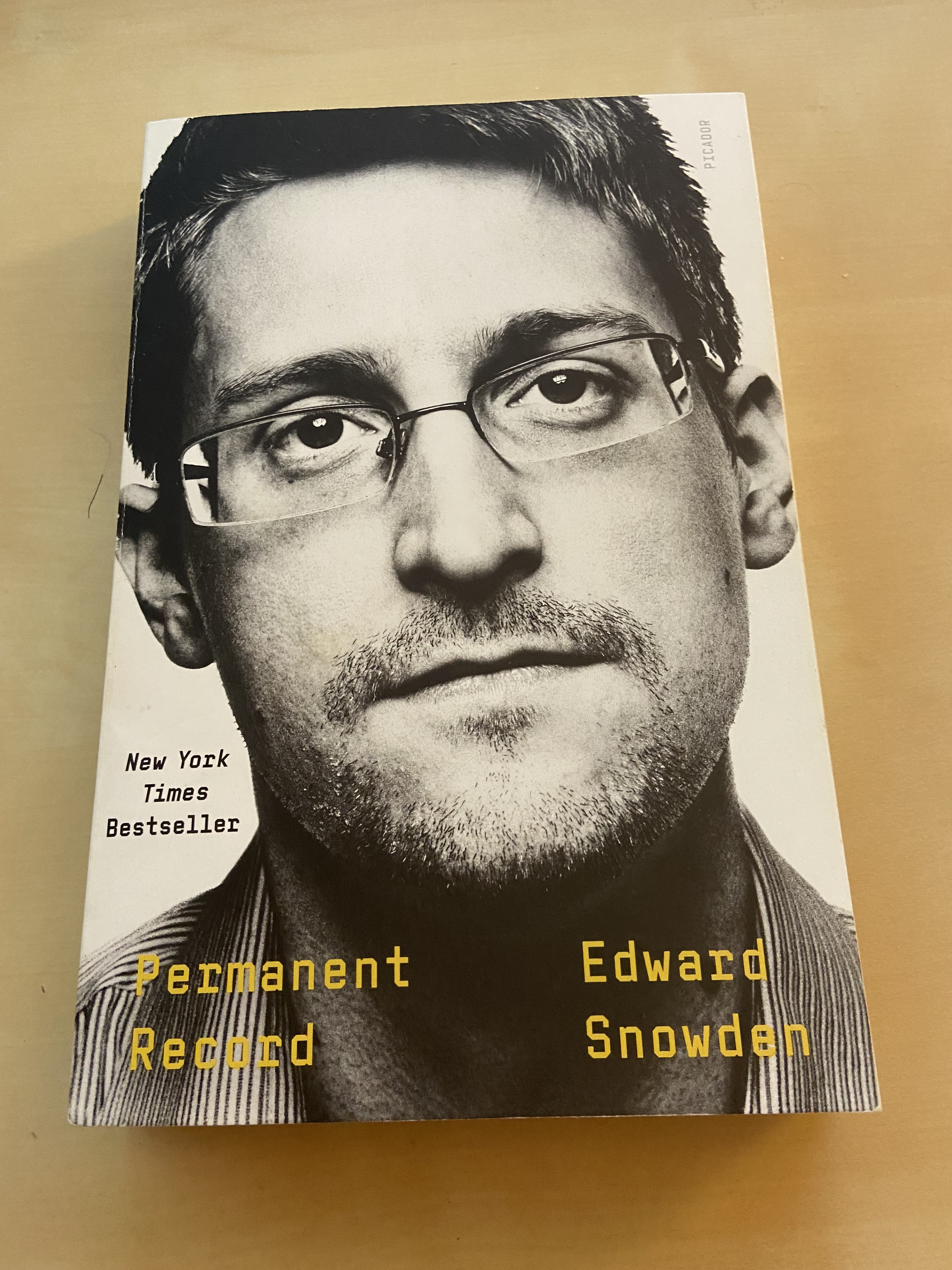
Permanent Record

Edward Snowden

Published: September 17th 2019

Read: June 22, 2021

This was not a well written book.

But more importantly, this also wasn’t a very interesting book.
There were some insights that I liked towards the end which made it entirely enjoyable enough for me.

Edward Snowden’s autobiography spans Snowden’s entire life and is a portrait of a man who seemingly has everything figured out.  This is a man who is trying to put his spin on the story, and build up his own character as a person of moral conviction, a child of civil servants who was instilled in his own mind the need to fundamentally serve his country.  A man who writes about his savant like interaction with computers throughout his childhood. A young man who took a noble stint in the military early on that got him injured,  where he was almost locked in Ft. Meade on 9/11.


This is a very stiffly written account, and unfortunately for me I may have been lead down this path when I saw an online review before finishing Permanent Record about the writing style.  That review managed to take the approach that Ed Snowden portrays himself as the smartest man alive.  Hey did you know, that video games got people into computers? Is just one almost painfully cringey few pages in the book. I suppose what I was looking for from this book was an instruction manual on how to use proper protection when dealing with nefarious denizens of the internet, coupled with the detailed events of how Snowden actually was extricated to Hong Kong where I watched the documentary CitizenFour by Laura Poitras. 


That documentary is much more interesting than this book. Other than a few references to using Signal for end to end encryption, and how in the wake of his actions, Congress has some larger level of awareness of private citizen surveillance than before, many details remain in the last third of the memoir. The material regarding the courts in particular and the methodologies available (or not) through the three branches of government were very enlightening. Specifically the limitations of information getting shared or even reviewed between the Legislature and the Judiciary. The interactions between Wikileaks and Snowden were very intriguing as well as the interactions between Ed and the Russian government.  I have nothing to base this on but the interactions with the Russians seems to be somewhat glossed over from what actually occurred, but that might be attributable to Snowden’s writing style.

One part that fascinated me was how did Ed managed to get his girlfriend to stick with him through this whole series of events. The way he tells it they were on the rocks to begin with and actually seemed to be totally broken up and then through some mysterious ways she extricates herself to Moscow with Snowden to get married and live their limbo criminal life. His efforts early on at metaphor approach my own sophistication when making some vague references to the Pantheon of Olympic gods to the intelligence community.

I don’t know Snowden, but he writes like any sort of anti-social nerd I’ve met throughout my life.  The tone becomes a bit grating because observations and deductions are stated as fact occurring a priori to Ed.  He’s the smart guy so it occurred to him to re purpose an old computer to make copies of programs from STELLARWIND or what have you.  Its also quite funny at bits.  Like the idea that in theory all program names are supposed to be random but that rule is constantly broken to get people having interesting sounding projects to work on. Alas, Permanent Record could have used more of this for me and less diatribes into Mario’s parallels to the information state.

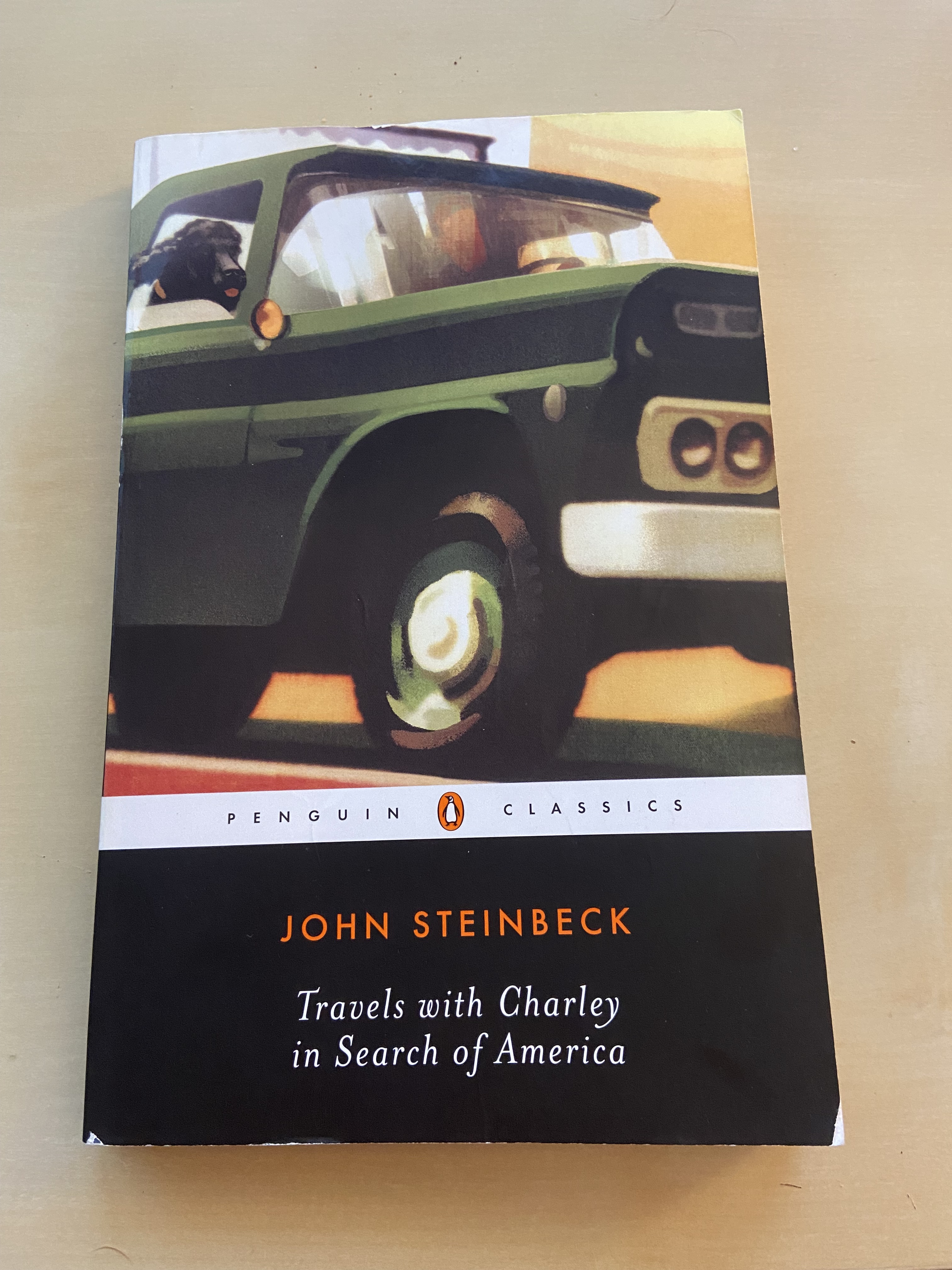
Travels with Charley: In Search of America

John Steinbeck

Published: 1962

Read: June 4, 2021

So I set off to read a travelogue by a novelist dead for 52 years in the year 2021.  The year where many across the world are longing to get to a new locale apart from their own work at home tombs.  Perhaps that opinion is only from just those of us who are sick of staring at the same four walls in this time of the pandemic, no matter.  John Steinbeck is a man from a different age.  He wrote Travels with Charley as a road trip memoir of a man, his dog, and his converted pickup camper.  And so, Casual drinking with strangers, lamenting the changing country and prevalence of freeways ensues.  Even with the salt of the earth topics, Steinbeck polishes his words to be profound and literary, but to my eye this is the voice of man long dead and who seems familiar.  While reading this book I kept thinking whether my grandfather as a younger man would have had the Steinbeck sensibility.  As described in Travels with Charley, Steinbeck was a veteran of World War II who was struggling to finish The Rise and Fall of the Third Reich. For days after, I wondered if he ever managed to finish the book or if that even mattered.


I should point out, the Charley in the title refers to Steinbeck’s pet poodle who accompanied Steinbeck throughout a traversal of the country. The travels, were a pleasant sepia-tone of a time a surprising long time ago told by a man who wasn’t engaged in the summer of love but was looking over his middle age and pushing into his own end. A man who styles himself as Don Quixote with his pickup truck christened the Rocinante.  This book is a time capsule who parallels today are uncanny and Steinbeck was a man who talked seriously and then took him self to be a fool clearly.  When lamenting on pasteurization he ends the argument with this

 
“The lines of change are down. we or at least I, can have no conception of human life and human thoughts in a hundred years or fifty years.  Perhaps my greatest wisdom is the knowledge that I do not know.  The sad ones are those who waste their energy in try to hold it back for they can only feel bitterness in loss and no joy in gain”


Steinbeck also comments on the nature of vaccine mandates which gave me a chuckle from here in 2021. Once he is trying to travel across the border into Canada he gets interrogated by the official at the border for charlies rabies shot. In this instance, Steinbeck shows me at least he is a rugged individual who is smart enough to know when to draw the line.

  
“And it is usually so with governments- not a fact but a small slip of paper”


” For this reason I cannot commend this account as an America that you will find. SO much there is to see, but our morning eyes describe a different world than do our afternoon eyes, and surely our wearied evening eyes can report only a weary evening world” 


There is some controversy (I googled) on this book of whether the events are true. I’m not entirely sure that this matters to my reading of the book or me as I got at least one mans view of the country in an older time and got some beautiful prose.  In any case as Steinbeck admits, the journey was a bit more of an idea than an actual experience held to plan.  As i look back through my highlights i find again no events that are worth pointing out but more the internal monologues of the man with the vision of a sleeping bag and a bottle of whiskey in the back of a pickup truck sleeping next to a dog.  


Many quotes nicely sit with as i read them and look back now, I hope I can keep it handy in the future for a sounding board on life. A book I thoroughly enjoyed reading in these times as a teleportation to a time and prose that felt warm and comforting if not a bit alien.


“I find this interesting, but it does make for suspicion of history as a record of reality”

Lincoln in the Bardo

George Saunders

Written: February 14, 2017

Read: March 28, 2021

As I started with this review, I thought that I should transcribe some quotes here, but ultimately I decided each individual quote taken just in a vacuum would just diminish the impact they had within this novel.  Lincoln in the Bardo is a surreal experience that plays with language and reality and transcending death. Which made it Jake’s beach read pick for the year.

Firstly, I didn’t like this book nearly as much as the short stories i read of Saunders after i read this (I’m writing this review in November 2021).  This book can best be described by me as a meditation.  Various characters are tent-poles of the many ways to live and what level of I suppose penance you need to pay to reconcile your past and become something beyond your life.  Oh and yes, this story does include President Abraham Lincoln.


Without spoiling much, the book is written so different characters change different prose styles which gives this novel a short story collection within a larger arc structure.  Its a novel of death primarily and a story of ghosts( or ghostly people or spirits or something else) grappling with their lives and moving towards some other afterlife.  It has a fantasy pastiche mashed into eastern religion. It left me somewhat unsatisfied but entertained and with a few more ideas floating around. I also am a person who has both prayed and meditated and considered the boundary between the two at the personal level over the years, so I may just not be as open to seeing this as fundamentally new. This is in contrast to when I read Siddartha by Herman Hesse a few years back which did give me a new perspective.

Ok I give up, I’ll put this quote here, this is probably better than any more commentary I can give:


“Tying a shoe; tying a knot on a package; a mouth on yours; a hand on yours; the ending of the day; the beginning of the day; the feeling that there will always be a day ahead. Goodbye, I must now say goodbye to all of it.”

This section comes towards the end of the novel and really gets to one of the core issues (or perhaps a core feature) of Lincoln in the Bardo. Ultimately this book should be read aloud, and towards having someone else read it and talk about, even if the impact it had was not new territory for me.