Walter Issacson
Published: March 9, 2021
Read: August 1, 2021
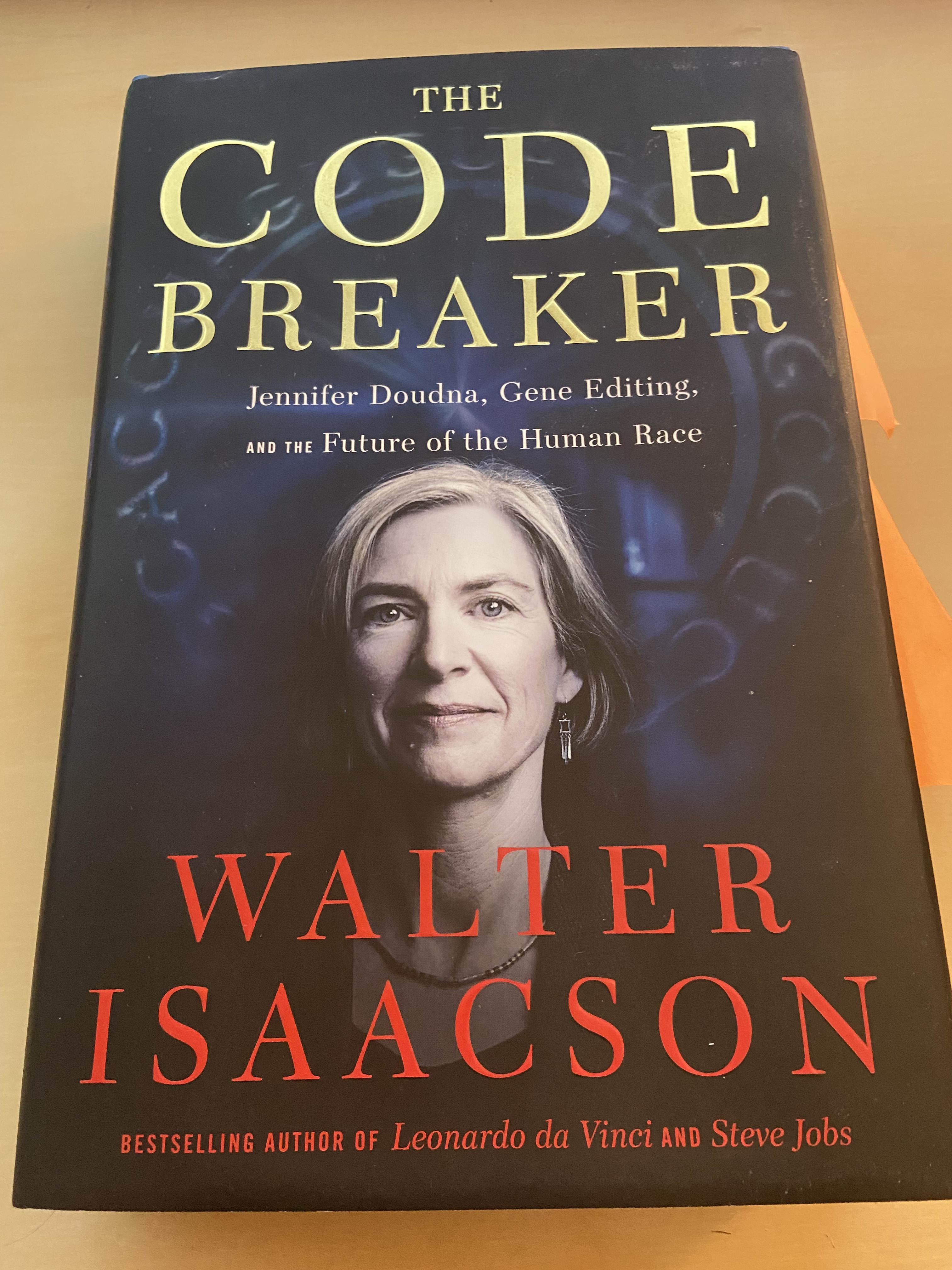
I was looking forward to reading this one. I am, by education and nature, someone who is firmly in the physics camp and not biology at all. Not to mention, someone who usually avoids all things blood, guts or biological. I’m also a man who likes to feel dumb from time to time. I’m most importantly a man who has seen the Ethan Hawke movie Gattaca. So I was excited in reading about genetic engineering, and having Walter Issacson (who’s books on Jobs and Einstein I liked) write it. This also was the start of my run of physical copy books I bought for a stretch in ’21 after the events of early this year (pictures above taken by yours truly). A good hardcover has always brought me comfort, even if it becomes a pain as I manage to move between apartments.
The Code Breaker presents itself on the outset as the story of Jennifer Doudna, an American biochemist who was one of the pioneers of using CRISPR, but ends up including wide cast of characters. I was a bit surprised, as Doudna’s mentors, mentees, and competitors take center stage for various phases of the book and she disappears for multiple chapters. When we do follow Doudna, her direct contributions, although scientifically significant, are presented in a way that seem minor or, quite matter of fact. I would guess this occurred one two ways, one the “miraculous” actions of a previous Issacson subject, Steve Jobs, add more drama to the page, than lobbying for government grants and creating small startups and quickly dissolving them within the medical (genomics) technologies industry. Doudna as a person just doesn’t have the same cult of personality as jobs so there wasn’t as much to dive into in her own speech or perspectives that wasn’t better suited to putting the community of scientists at the fore. Seems like from the cover and the sub title Doudna was intended to be the main focus before expanding the cast.
This book felt quite light on material. The color printed photos included are interesting for matching names to faces, but full head shots on single pages felt like they were also there to push the count up to warrant the hardcover size. Issacson’s also takes pages out of the book (whole chapters actually) proposing thought experiments in genetics as opposed to documenting the scientific state of things or simply quoting other ethicists in the field. Generally, Issacson’s voice is very present in this book to its detriment. Constantly pointing out the possible ramifications of this tech without letting us hear it from the horses mouth. He also may be a bit over worried about losing readers in the technical details and then pauses to hash them over and at least to me it seems unnecessary. I find it odd to think who the audience is that hes trying to placate with this method.
This was a very recently published book on an evolving field as
Gripes aside, I still was happy to have had an introduction to the genomics field and learned many things far outside my wheel house, but I have to think there may have been a better book to do it. As i link below all these people discussed are alive and working in the field today so you can look at who went to what companies and is working on what projects immediately. This is a nice change from reading about many Presidents long dead or fictional characters. I hope that I can find some more books, videos or lectures to help me understand better the field as I see reports in the news.
I don’t want to dive more into the actual here so I’ll just list some personal notes I found interesting.
Random Observations
- The Germline is the portion of genetic material that you pass onto your offspring as opposed to genes that will not. Some genetic editing debates described in The Code Breaker are centered around crossing the germ line.
- Doudna’s early work parallels some of the feelings my own path in electronics design engineering
- “Never do something a thousand other people are doing”
- Replication of RNA is independent of DNA
- In scientific publications the first author is the hands on scientist (usually younger or a grad student) and the last author runs the lab the experiment was run in.
- Genomics made a shift from RNA to DNA editing.
- Tansopons : jumping genes
- “phase problem” crystalography
- This is the second book I read this year that discusses The two-body problem in academics.
- The dicer enzyme is part of a coronavious the messanger RNA method to develop the rececnt COVID-19 vaccines.
- There are 92 Cas genes\CRISPR associated enzymes
 John (Jake) Kolb III