Doris Kearns Goodwin
Published: September 18, 2018
Read: May 29, 2021
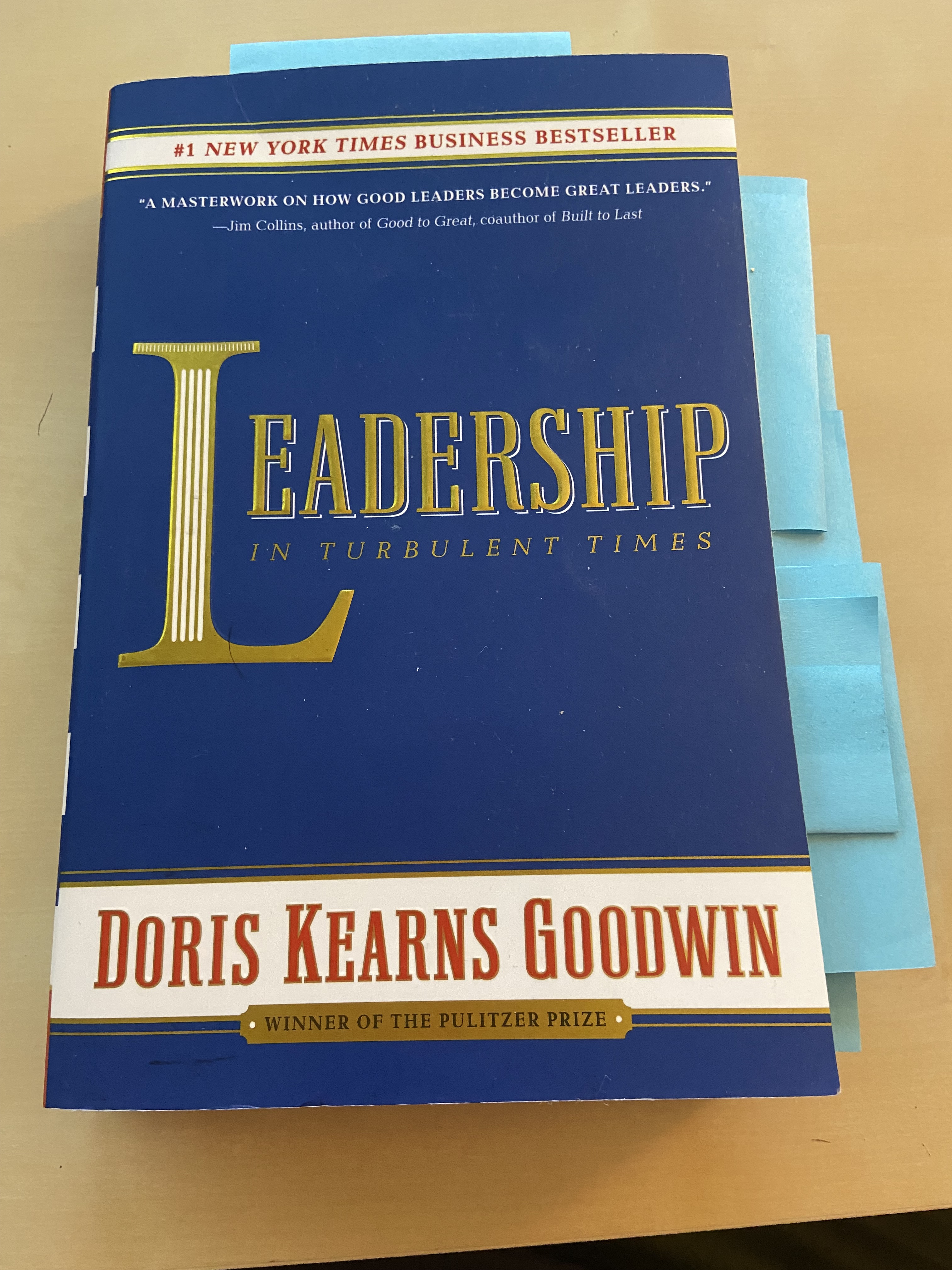
To be honest, I read this book to see how I stacked up to presidents. Its not flattering to admit. Until the events of 2020 I had a low regard for presidential or any leadership.
At some point the human at the top is irrelevant, right? The process and system (checks and balances) put into place supersedes anything that a single actor man can do. Public polls, the press and the gossip feedback loop of the 24 hour news cycle (featuring twitter) and perpetual internet click bait had me convinced of the lack of agency or impact leaders actually have.
At some point during the COVID-19 pandemic, observing a leader focusing intently on proving his critics wrong and maintaining a winning argument, in contrast to attempting to create some connection with the millions watching him on the screen my mind changed. I found myself realizing that perhaps not legislatively but psychic a leader of men must represent those men and there is value to that psychic collective as opposed to just the nuts and bolts of legislation. No matter how large the organization there is calm, or direction, or purpose that can be put into one man who can make a difference. Coming out of Leadership in Turbulent Times helped me in this regard.
Goodwin separates the portions of the book into the phases of each Presidents career rather than making a section on a single man. The early years, middle phase, and presidential leadership principles are hit for each man. I presume that much of the material discussed here was already covered in her other books, but based on my remembrances of reading 40 pages of Team of Rivals in 2010, the Lincoln material at least seems to be reaching further back in time that what that books focus was. This time phasing of each of the men really is straddling to see how each dealt through phases of their own life. From early days to the peak of their presidential contributions to leadership and then their post presidential years.
Goodwin frames Leadership as a guiding framework or case study more than a direct history. Digging further into the working mental modes of each of the presidents and highlighting their differing personalities which is shown more in the early years and reinforced later. Lincoln comes off as a massive depressive who is willing to experiment and shift his positions as he and the country developed. Teddy Roosevelt singular focus on engaging with the large beasts whether they were physical or metaphorical. Franklin Delano Roosevelt smiling and laughing with his friends and as his body failed him. Lyndon Johnson working frantically through his life from being an educator to a politician.
Now I’ll write about me again! What is my own leadership style? To grab something and polish it until it’s fit to spit back out. Like Lincoln with the hard piece of metal slowly scratching into it until its bound to the memory for all time. Or am I more Johnson-esque “freeze out”, showering co workers with affection and assuming performance and loyalty until that fades and then I withdraw entirely. After reading this book, I would like to be a badass like Teddy Roosevelt, LBJ makes me feel like i don’t work hard enough, Lincoln would be just as depressed as i was and we wouldn’t have any fun, and FDR isn’t someone I want to hang out with no matter how much he lead America through a trying time.
Interesting to note that each of the presidents were connected to the previous in a way. Roosevelt used Lincoln numerous times as a basis, FDR as Theodore as well and Johnson was directly the protege of FDR going forward.
Yet the core of the book is an examination of four men who just happened to be president and analyzing how they dealt with the needs of the office with different strategies.
Self help has run dry for me in my 30s so perhaps history can help
Abraham Lincoln
What is well-spoken must be yoked to what is well-thought. And such thought is the product of great labor, “the drudgery of the law”. Without that labor, without that drudgery the most eloquent words lack gravity and power”
Supreme Court Justice Oliver Wendell Holmes Jr. About Franklin Delano Roosevelt
“A second class intellect but a first class temperament”
Theodore Roosevelt
” Do what you can, with what you have, where you are.”
Lyndon Johnson
“You have to realize that a politician -a good one – is a strange duck”-

 John (Jake) Kolb III