Edward Snowden
Published: September 17th 2019
Read: June 22, 2021
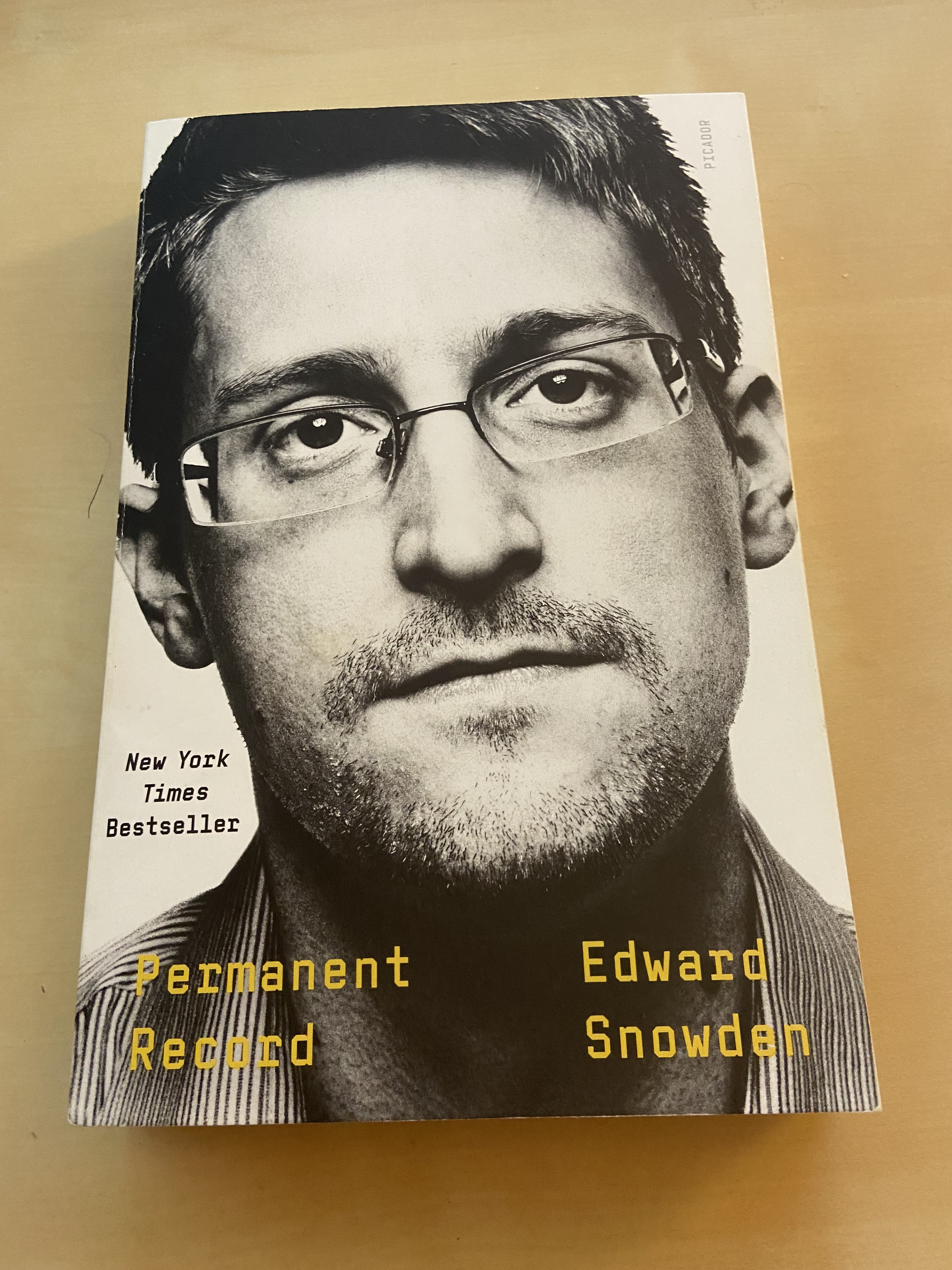
This was not a well written book.
But more importantly, this also wasn’t a very interesting book.
There were some insights that I liked towards the end which made it entirely enjoyable enough for me.
Edward Snowden’s autobiography spans Snowden’s entire life and is a portrait of a man who seemingly has everything figured out. This is a man who is trying to put his spin on the story, and build up his own character as a person of moral conviction, a child of civil servants who was instilled in his own mind the need to fundamentally serve his country. A man who writes about his savant like interaction with computers throughout his childhood. A young man who took a noble stint in the military early on that got him injured, where he was almost locked in Ft. Meade on 9/11.
This is a very stiffly written account, and unfortunately for me I may have been lead down this path when I saw an online review before finishing Permanent Record about the writing style. That review managed to take the approach that Ed Snowden portrays himself as the smartest man alive. Hey did you know, that video games got people into computers? Is just one almost painfully cringey few pages in the book. I suppose what I was looking for from this book was an instruction manual on how to use proper protection when dealing with nefarious denizens of the internet, coupled with the detailed events of how Snowden actually was extricated to Hong Kong where I watched the documentary CitizenFour by Laura Poitras.
That documentary is much more interesting than this book. Other than a few references to using Signal for end to end encryption, and how in the wake of his actions, Congress has some larger level of awareness of private citizen surveillance than before, many details remain in the last third of the memoir. The material regarding the courts in particular and the methodologies available (or not) through the three branches of government were very enlightening. Specifically the limitations of information getting shared or even reviewed between the Legislature and the Judiciary. The interactions between Wikileaks and Snowden were very intriguing as well as the interactions between Ed and the Russian government. I have nothing to base this on but the interactions with the Russians seems to be somewhat glossed over from what actually occurred, but that might be attributable to Snowden’s writing style.
One part that fascinated me was how did Ed managed to get his girlfriend to stick with him through this whole series of events. The way he tells it they were on the rocks to begin with and actually seemed to be totally broken up and then through some mysterious ways she extricates herself to Moscow with Snowden to get married and live their limbo criminal life. His efforts early on at metaphor approach my own sophistication when making some vague references to the Pantheon of Olympic gods to the intelligence community.
I don’t know Snowden, but he writes like any sort of anti-social nerd I’ve met throughout my life. The tone becomes a bit grating because observations and deductions are stated as fact occurring a priori to Ed. He’s the smart guy so it occurred to him to re purpose an old computer to make copies of programs from STELLARWIND or what have you. Its also quite funny at bits. Like the idea that in theory all program names are supposed to be random but that rule is constantly broken to get people having interesting sounding projects to work on. Alas, Permanent Record could have used more of this for me and less diatribes into Mario’s parallels to the information state.
 John (Jake) Kolb III