Termination Shock

Neal Stephenson
Published: 11/16/21
Read: 12/28/21

Termination Shock takes its time, and is quite meandering for a thriller. After 800 some pages, the book makes me feel like I only watched the Season 1 finale of the a new slow burn TV series.

Termination Shock is set in the near future, is centered around climate change, and one individuals efforts to do something about it himself. That man is TR Schmidt, and his plan is to launch rockets to blast sulfur dioxide in the air from his ranch in Texas. Oh and also to collect a cabal of people to back him in his play for spreading this radical geoengineering scheme across the globe. The characters being charmed by the renagade Texan include the Queen of the Netherlands, Venetian nobles (who are quite bitter about their city potentially being demolished), and the mayor of the City of London amongst others.

I find writing this synopsis now, that I’m still excited about Termination Shock and this premise even a month after I finished reading. The pieces are set for a massive adventure with high stakes and big reveals, double crosses and ramifications echoing across the globe. I will admit, part of the fun I expected and did get a good bit of were the classic Stephenson tropes. There are plenty of the “big ideas”, scientific theories, cultural observations, and inane trivia swirling around our main plot that can spawn many separate internet deep dives on their own (see my Random Observations). And this is the demise of the excitement as Termination Shock progresses. Ultimately, the backstory of how a certain character develops a personal vendetta against wild boar hunting is more exciting than the revelations of climate change and how to change it. What left me feeling unfulfilled was the entry trailer, how would the world would be impacted by attempting this geoengineering. There are hints but no substantial answers, which left me feeling I missed the unwritten second half. Even towards the close of the book, there’s a growing conflict between two characters on different factions (a Cowboy and Indian showdown) that seems to cram in some excitement but at the expense of the contrast to the other 90% of the events.

In reading a novel about climate change, I was also a tad bit confused about the weather in this near future earth and how bad things actually were. The very intriguing earthsuits, full body suits that cool body temperature through liquids and air circulation are introduced within the first couple of pages and maybe it was my sci-fi expectations, but they don’t even reappear in a major way until the very end of the book. It also appears that they simply aren’t necessary except for maybe certain parts of Texas at high sun as opposed to generally applied across the earth. Not to mention, I was longing for Chekov’s earthsuit twist that never seemed to arrive.  

A high note is that in comparison to the “seven eves” of Seveneves I did have a connection to these characters in for what little time I spent with them.  Much like the characters in Reamde, but they frankly didn’t get to do much before the whole thing was over besides worry about whether or not our main character TR Schmidt was actually trying to achieve what was laid out on the blurb in advance of reading.

The entirety of Termination Shock, the reader is within characters perspectives who are not at the seat of the action. This isn’t intuitively bad but overall gives the feeling that the book kind of didn’t have a climax. The action is driven by TR who is continuously out of the understanding of each of the characters we spend time with.  Not to mention the Chinese involvement which is continuously under explained, or the perspective of anyone in the US government who notices a huge set of rocket launches occurring in Texas to pump sulfur in the atmosphere.  Stephenson does make his jabs at the current government through this lens and mentions the decline of America once or twice here as well as the events of the January 6th capital riot. T.R. is the sole American but the extreme rugged individual, and he is more the agent of chaos than the main character.

Perhaps this is intentional, Stephenson alluding to the fact that changing the climate is precarious, difficult and perhaps hes hinting the plan may never work. Either way the ending simply is not the end.

“Don’t worry, in Season 2 the Queen of the Netherlands might actually get with the Comanche Ex military guy. The wild Texan might actually get assassinated by the Chinese. The Dutch diplomat might actually… do something? “

Random Observations

  • Stephenson’s bibliography on climate and geo engineering topics as well as other interesting things in the general history of the world is probably going to help my “To Read” list for the next 30 years.
  • The Line of Actual control plays into a big chunk of this book. I learned it is an Actual thing, and its fascinating.

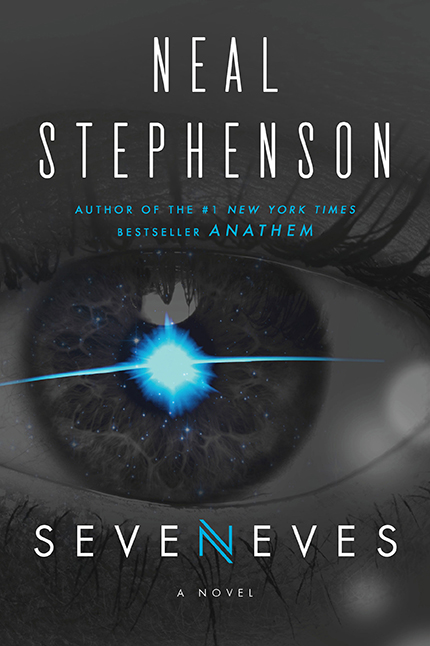
Seveneves

By: Neal Stephenson

Published: May 19, 2015

Read: 11/7/2021

It took me a few years to finish this book. I started it back in 2016 and abandoned it with the comment of “ sometimes when struggling with an intense day of electronics work reading a fictionalized account of an engineers design flaw in an asteroid mining robot may keep me from relaxing”. Now at the end of 2021 and a bevy of other more grounded books and frankly less electronics design in my daily life, I was ready to return to this math problem disguised as a novel.


One thing to note is that I did audio and print on this one and I think this is honestly the only way I’ve gotten through any of Stephenson’s novels or any long novel in recent memory. The amount of time I dedicate to reading is not nearly enough to finish these tomes in a month or so sitting which I like to do and I have yet to find a book where I’m comfortable or enjoy putting it down and forgetting the first half while I push through to the ending. This is the only way I could possibly finish this thing in the course of four weeks while riding the stationary bike and the occasional Sunday absorbed into Stephenson’s orbital mechanics diatribes. I did ask myself while reading this book who it was for. I know there are many mechanical engineers out there who would love it but how many normal citizens would really sit through these passages. No matter, onto the book.


Seveneves is split into two parts, the first half being a high stakes extra orbital drama after the Moon simply breaks apart. Stephenson is very clear that the book does not attempt to get to how or what caused that separation, his characters refer to “The Agent” of the moons discussion fairly briefly, because more pressing matters begin to arise. Namely the parts of the moon that are breaking apart in orbit with the earth begin to collide in an exponential rate and will eventually encase the earth in a particle cloud, after bombarding the planet excessively, this event is referred to as the “white sky”. This cloud of particles will ensure that no living creatures can survive on the surface of the earth any longer.


This precipitates a space race to get as many people as possible into orbit around earth to survive. The beginnings of this earth outpost start with the international space station and are built upon by a modular spaceship design designated as “Arklets” . Each of these can be connected or separated with the idea that each situation might be ideal for the realities of space flight. This section also deals heavily with the mission of one asteroid mining executive who believes wholeheartedly that the humans remaining within earth orbit are royally screwed without additional water reserves. In this point he goes to retrieve a giant icy comet fragment and manages to secure that at sever risk to himself and other compatriots.
To describe the amount of things that can go perilously wrong in establishing a permanent civilization today in orbit around the planet are numerous to describe but Stephenson does a wonderful job here of making this entire section of the book non stop issue after issue. Apart from the water reserves you have random micrometeorite impacts, radiation destroying electronics, slowly drifting into the atmosphere which is expanding as the earth heats up after being bombarded with moon particles, the politics of who got to survive and what should be the structure of the new society if species ending events would ever cease, a bargain of whether or not to stay in orbit or run to mars, how to kill someone in zero g, and the necessity of cannibalism to say the least.

At this point mentioning anything in the second half would be a spoiler so if you are interested in any of these topics please read Seveneves so we can chat about some of these sections in length and draw the orbital paths of the ISS and whether or not creating electro-mechanical whips to move people through space is a better idea than solid state rocket boosters, if not then I’m so happy that your social life is much more engaging than my own.


The significance title of the novel is brought to light only after say 550 pages in where the remaining 8 survivors of the human race are all women albeit one who is no longer able to have children. This section specifically ties nicely with my recent reading of The Code Breaker and the ramifications of utilizing gene sequencing technology. As the eight are huddled together safely nestled into a cold notch within a large piece of the former moon they look to the future of humanity. And they have a space genetics lab and the digital library of DNA of every living species on the planet including humans. They decide collectively that each woman has the right to alter one aspect of their offspring in this time and hence they guide the course of the human race into seven separate races of humans, each with their own characteristics.


At this point the novel jumps 5000 years in the future after these seven races have expanded out from that small rock into an orbiting ring around the planet. Terraforming is proceeding on earth to try to make the planet livable again and there are a two teams setup within the society simply placed as red versus blue. I will stop here because I took about a week off between these two parts as you could actually in my mind have two entirely independent books or maybe a whole series based on this second half. Stephenson seems to be playing with the idea of fantasy races, one race optimizes for physical strength and muscle mass, one for leadership qualities, one for intellect, one for charisma and deception, etc… The rough bit here was the premise that I had a really good feel for most of the characters in the first half. I was very close to Dinah (bold adventurer type), Ivy (cool headed leader type), Tekla (Russian badass fighter type), but as opposed to the scheming former president Julia the other four were just a blur to me and it didn’t impact as hard as it could have.
Then again many pages were spent on this book and I think there is something to be said for finishing an idea and getting it out there rather than making a series and stretching these things to their limit.Stephenson does (in a positive way) the minimum to get his point across and pulls the rip cord and moves on. Not to mention is dubious whether the characters are really the point here or just the high level stuff. Orbital mechanics, how to evacuate the planet, how to restart humanity. These seem to be his priority, I only wonder if someone was to write a whole series of books in the later setting what stories could be told of the people living there and dealing with it.


No matter what evolves is a quest of old where each race of human is represented to go on a mysterious quest into the frontiers of the earth and see whats going on. There’s a bit of hand waving here (or maybe I was tired when reading) about why they are actually going on the journey, whats in it for each of the members and what the real goal was before the events actually transpire, but to put it shortly (which Stephenson does not) the section culminates into discovering that there are actually other humans who survived both under the ground of the earth “the diggers” as well as under the sea people “the pingers” who descended from a group of military officers who originally were stuck in a submarine at the time of the white sky. There’s again a lot that isn’t really explained because that wasn’t the point of the novel about how exactly both of these groups survived, but the contrast is between what we have followed in the “spacers” journey of the seven eves as opposed to these other two parallel societies. To me it Seveneves thoughts on humanity is to take it at face value, it is imperfect and each society has their own ways of trying to make the whole thing work, conflict is inevitable and eminent domain issues are always the toughest ones to muster. There are some allusions I think overtly or not so with regards to the diggers use of bows and arrows and the native Americans.


Ultimately the book ends with these groups making alliances and formally understanding their cousin species are out there, but nothing is written and nothing is easy. Again Seveneves seems like two books to me that could each stand on their own but the second half seems to warrant much more development rather than a wisp of a plot pulled together in order to write an analysis of what else may happen to humans in a 5000 year span.

5000 years. A span of time I thought I could wrap my head around.

Here are a timeline milestones in the last 5000 for you:

  • 5000 years ago: First use of a solar calendar of 365 days
  • 4000 years ago: Earliest abacus and use of coal, decline of the Bronze age civilizations in Egypt Greece and Mesopotamia
  • 3000 years ago Start of the Iron Age, iron replacing bronze for tools and weapons
  • 2000 years ago: Rise of the Roman empire.
  • 1000 years ago: The Crusades, windmills paper money